Why Your Website Redesign Failed (And How to Build One That Actually Generates Pipeline)

Six months ago, you launched your new website. Maybe a design agency walked you through beautiful mockups in that final presentation, and the colors were on-brand, the animations were smooth, and your CEO loved the modern aesthetic. Or maybe you went the practical route: hired a developer to customize a template, kept costs down, got it done quickly. Or perhaps you brought in an SEO agency that promised page-one rankings and stuffed your site with keywords and optimized meta descriptions.

Different paths. Same outcome.

Your lead volume didn’t budge. I might have even dropped. Your sales team still complains that the site doesn’t help them close deals. The CFO is asking pointed questions about ROI in budget reviews. And you’re stuck defending an investment (whether six figures or $15K) that either looks great but converts poorly, loads fast but confuses visitors, or ranks well but drives the wrong traffic.

If this sounds familiar, you’re not alone. And more importantly, it’s not your fault.

In our 30+ years designing websites, we’ve watched this pattern repeat many times, for both B2B and B2C companies. We’ve been called in to fix failed redesigns from prestigious agencies, offshore development shops, template customizers, and SEO specialists. This has given us a front-row seat to what goes wrong and why.

The creative agency that optimized for their portfolio instead of your pipeline. The template approach looked fine, but had zero connection to your actual buyer journey or competitive positioning. The SEO company that got you traffic but forgot that humans, not search engines, need to convert once they arrive.

Here’s the uncomfortable truth: most website redesigns fail not because of budget or technology, but because they’re approached from the wrong angle entirely. They’re executed as creative projects, technical projects, or traffic projects, but rarely as revenue projects. And they’re measured by subjective opinions (“Does the CEO like it?”), technical metrics (“Did our speed score improve?”), or vanity metrics (“We’re ranking #3 for this keyword!”), instead of the only thing that actually matters: Did it generate more pipeline?

But it doesn’t have to be this way.

Here we break down the four reasons your redesign probably failed—whether you spent $5,000 or $150,000—and more importantly, show you what a revenue-focused web strategy actually looks like. Because after three decades in this business, we can tell you with certainty: your website can be your most effective salesperson. It just needs to be built like one.
The 4 Reasons Your Redesign Failed

The 4 Reasons Your Redesign Failed

Let’s get specific about what went wrong. We’ve categorized tons of failed redesigns, and the patterns are remarkably consistent, regardless of whether you spent $5,000 or $150,000.

1. You Hired Specialists, Not Revenue Partners

Here’s what probably happened: You hired people who were excellent at their craft, but that craft wasn’t “generating B2B pipeline.”

The design agency optimized for aesthetics and their portfolio. They cared deeply about typography, white space, and making sure the site looked stunning on Awwwards. They measured success by whether the site won them new clients, not whether it won you new customers. They didn’t understand your 6-month sales cycle, your buying committee structure, or why your prospects ghost after the demo.

The template developer got you online quickly and cheaply, which seemed smart at the time. But they never asked about your competitive differentiation, buyer objections, or what questions prospects ask sales before they buy. They customized colors and swapped in your logo, but the underlying structure was built for a generic business, not your business with your specific value proposition and your buyer’s journey.

The SEO agency got you ranking. Traffic went up. You’re on page one for several keywords. Fantastic! Except the traffic doesn’t convert because the pages were written for Google’s algorithm, not for your actual buyers. The content answers the question “what will rank?” instead of “what will persuade a CFO to take a meeting?”

None of these providers are bad at what they do. They’re just optimizing for the wrong outcome. And if you didn’t explicitly hire someone to generate pipeline, you shouldn’t be surprised when they didn’t.

2. You Redesigned the Wrong Things

Most redesigns focus on the visible stuff while ignoring the structural problems that actually kill conversions.

You got a refreshed color palette when you needed clearer value proposition messaging. You got new photography when you needed better-articulated competitive differentiation. You got a reorganized navigation when you needed conversion paths mapped to buyer intent.

Here’s what we see constantly: The homepage gets completely rebuilt with beautiful hero sections and brand videos. Meanwhile, your core service page, where prospects actually spend time deciding whether to contact you, still has vague descriptions that could apply to any of your competitors. Your case studies page is still a boring grid of logos. Your pricing page still doesn’t exist because “we prefer custom quotes,” which just creates friction.

Or you went the template route and got locked into pre-built sections that don’t map to how you actually sell. You needed to explain a complex ROI calculation, but the template gave you three icon boxes and a testimonial slider.

Pretty doesn’t fill your pipeline. Strategic content architecture does. A $20,000 site with laser-focused messaging and clear conversion paths will outperform a $150,000 site with gorgeous design but vague positioning every single time.

The redesign should have started with “What do prospects need to believe and understand at each stage to move forward?” Instead, it started with “What should the site look like?”

3. Your “Strategy” Was Actually Just a Sitemap (or Template, or Keyword List)

Let’s talk about what you may have been sold as “strategy.”

The agency version: A 40-page deck with competitive analysis (screenshots of competitor homepages), user personas (demographic info pulled from your CRM), and a sitemap showing your new page structure. Lots of process diagrams about their methodology. Nothing about how a prospect moves from problem-aware to solution-aware to vendor-evaluation.

The template version: “Here are the sections included in the template.” The strategy was choosing between Template A and Template B. No discussion of buyer psychology, competitive positioning, or what objections need to be overcome before someone fills out your contact form.

The SEO version: A keyword map showing which pages will target which search terms. Volume and difficulty scores. Technical recommendations for site speed and crawlability. Zero consideration of what happens after someone clicks through from Google—will they immediately understand why you’re different? Will they find answers to their actual questions? Who knows. That wasn’t in scope.

Real strategy means understanding buyer intent at each stage, mapping competitive differentiation into every page, and designing deliberate conversion paths based on how deals actually close in your business. Real strategy asks: “What does a CFO need to see before they agree to a demo?” and “Where do prospects typically drop off in our sales process, and how can the website address those concerns earlier?”

4. Launch Day Was the End, Not the Beginning

Here’s the final nail in the coffin: Your provider treated launch as the finish line.

The agency sent the champagne emoji, posted your site to their portfolio, and moved on to the next client. The template developer handed over the login credentials and closed the ticket. The SEO company set up monthly ranking reports and switched to maintenance mode.

And your website became a static digital brochure that sits unchanged for the next 2-3 years until you get frustrated enough to redesign it again.

But here’s what we believe at Bynder Group: Your website should evolve based on what’s actually working. You should be testing headlines, repositioning CTAs, adding new case studies as you close deals, updating messaging based on sales feedback, and refining pages based on where prospects drop off.

The companies with websites that actually generate pipeline treat their site as a living revenue engine, not a launch-and-forget project. They have monthly optimization roadmaps. They run A/B tests. They update content quarterly. They track which pages correlate with closed deals and double down on what works.

Your redesign probably came with no testing plan, no optimization roadmap, no feedback loop between website performance and sales outcomes. It was a project with a start and end date, not a system for continuous improvement.

That’s why six months later, you’re sitting on a beautiful (or functional, or ranking) website that isn’t generating the pipeline you need.

Sound familiar? Let’s talk about what actually works.

What a Revenue-Focused Website Strategy Actually Looks Like

What a Revenue-Focused Website Strategy Actually Looks Like

Here’s the approach that actually generates pipeline. It’s not sexier than the agency process, it’s not cheaper than the template route, and it’s not quicker than the SEO play. But it works.

Foundation: Start With Revenue Goals, Not Design Trends

Before we touch a wireframe or write a single line of code, we start with your revenue operations (RevOps).

How many leads do you need per month? What’s your typical deal size? What’s your close rate? How long is your sales cycle? What does your buying committee look like?

These aren’t marketing questions; they’re revenue questions. And they drive everything.

If you need 50 SQLs per month to hit your revenue targets, and your site converts at 2%, we can work backward to figure out exactly how much qualified traffic you need, which pages matter most, and where to focus optimization efforts. Only then do we start thinking about design, content, and structure.

Here’s a real example: We worked with Hydration Room, a multi-location IV therapy and wellness clinic backed by private equity with aggressive growth targets. They had strong word-of-mouth (38% of new revenue), but customer retention averaged just 6.5 months, and their booking process was hemorrhaging potential clients.

We started with their growth target—10%+ annual revenue increase—and worked backward. We mapped their entire customer journey, identified where prospects were dropping off (complex booking process, lack of treatment guidance, inconsistent follow-up communications), and rebuilt those conversion paths while integrating their fragmented tech stack. The result: projected 10%+ revenue growth with extended customer relationships and streamlined operations that actually support scaling.

The principle applies whether you’re B2B or B2C. Revenue goals drive everything.


Strategy: Build for the Buyer Journey, Not Your Org Chart

Your website should mirror how buyers actually research and make decisions, not how your company is organized internally.

This means doing the hard work up front:

  • Interviewing your sales team about the questions prospects ask before they buy
  • Analyzing which objections come up repeatedly and at which stage
  • Understanding what your buyers care about at the awareness stage (spoiler: not your company history) versus the decision stage (competitive differentiation, implementation details, proof)
  • Mapping content to each stage: educational content for early-stage researchers, comparison content for active evaluators, proof points for final decision-makers

We see this mistake constantly: Companies structure their site around their service offerings or departments because that’s how they think about the business. But a prospect researching solutions doesn’t care that you have separate divisions for “Strategy” and “Implementation.” They care about solving their problem, understanding if you’re credible, and knowing what makes you different from the three other vendors they’re evaluating.

Buyers don’t care about your company structure. They care about solving their problem. Your site should reflect their journey, not your departments.

Every page should answer a specific buyer question at a specific stage. Your homepage isn’t for everyone; it’s for first-time visitors who need to quickly understand what you do and why it matters. Your service pages aren’t feature dumps; they’re for prospects evaluating whether you solve their specific problem better than competitors. Your case studies aren’t just logos and quotes; they’re proof that you’ve done this before for companies like theirs.

Execution: Design for Conversion, Not Awards

Once the strategy is locked, design becomes much simpler: every page needs a clear purpose and a measurable goal.

Not every page’s goal is “get a form fill.” Sometimes it’s “move to the next stage of research,” or “overcome a specific objection,” or “build credibility.” But there’s always a goal, and the design serves that goal.

This means:

  • Strategic CTAs based on page intent (early-stage content offers a relevant resource, not “Book a Demo”; decision-stage content offers the demo)
  • Trust elements positioned exactly where buyers hesitate (client logos after you make a bold claim, case study links after you describe your approach, security badges near form fields)
  • Mobile-first design because B2B buyers research on their phones after hours, not just at their desks
  • Fast load times not because Google rewards it, but because prospects bounce if they’re waiting
  • Clear, scannable content because executives don’t read every word; they skim for relevance

We’re not anti-beautiful design. We are a design-first agency and love beautiful design. But beauty serves conversion, not the other way around. If a gorgeous animation slows your page load and increases bounce rate, it goes. If a minimalist layout hides your value proposition, we add more content. Function drives form.

The question we ask about every design element: “Does this help a prospect move closer to becoming a customer?” If the answer is no, it doesn’t belong.

Optimization: Treat Your Website as a Revenue Engine

Here’s where most redesigns completely fall apart and where the biggest opportunities live.

Your website isn’t done at launch. This is just the beginning.

A revenue-focused approach includes:

  • Built-in analytics and conversion tracking from day one. Not just Google Analytics pageviews, but actual conversion tracking tied to your CRM so you can see which pages and traffic sources generate pipeline and revenue, not just clicks.
  • Monthly testing and optimization plans. We test headlines, CTA placement, form length, and page structure. We learn what resonates with your actual buyers and double down on what works.
  • Regular content updates based on sales feedback. When your sales team hears a new objection repeatedly, we add content that addresses it. When a competitor launches something new, we update comparison pages. When you close a major deal, we turn it into a case study.
  • Quarterly performance reviews tied to pipeline metrics. We don’t care if traffic is up 20% if leads are flat. We care about SQLs generated, pipeline influenced, and ultimately, revenue attributed.

We’ve seen every stage of web evolution since the days of “you’ve got mail”, from Flash intros to mobile-first to AI chatbots. The technology changes, but the principle doesn’t: The winners aren’t those who launch and forget. They’re those who test, learn, and improve continuously.

Your site should get better every month. New insights from closed deals should feed back into your messaging. A/B tests should reveal what actually persuades your buyers. Analytics should show you exactly where prospects drop off so you can fix those conversion leaks.

Most agencies can’t do this because they’re already working on the next client’s launch. Template providers can’t do this because there’s no ongoing relationship. SEO companies won’t do this because they’re focused on rankings, not revenue.

The Difference at a Glance

Traditional Approach Revenue-Focused Approach
Starts with design trends, templates, or keywords Starts with revenue goals and buyer journey
Measures success by launch date, aesthetics, or rankings Measures success by pipeline generated
Ends at go-live Includes ongoing optimization and testing
Pretty pages or optimized meta tags Strategic conversion paths
Your org chart = site structure Buyer journey = site structure
One-time project Continuous revenue system
Provider disappears after launch Partner accountable for results

A revenue-focused approach treats your website as a growth system and the relationship as a partnership

The Real Difference: Partnership vs. Project

Let’s be clear about what we’re really talking about here.

The traditional approach, whether high-end agency, template developer, or SEO specialist, treats your website as a project. There’s a scope, a timeline, a deliverable, and a handoff. You’re buying a thing. The relationship ends when the thing is delivered.

A revenue-focused approach treats your website as a growth system and the relationship as a partnership. You’re not buying a website. You’re building an ongoing capability to generate pipeline.

What does that partnership actually look like?

Alignment workshops where we sit down with both sales and marketing. Not just to gather requirements, but to understand how deals actually close, where prospects get stuck, what questions come up in late-stage conversations, and how your best customers discovered and evaluated you.

Access to 30+ years of B2B conversion data and patterns. We’ve seen what works across hundreds of industries and thousands of buyers. We know that B2B software buyers need to see security information earlier than they used to. We know that CFOs respond differently to ROI messaging than operations leaders do. We know which page structures convert and which create friction. You get the benefit of all that pattern recognition.

Shared accountability for pipeline metrics. We don’t just report on vanity metrics and walk away. Our success is measured by whether your site is generating the SQLs and pipeline you need. If it’s not, we’re as motivated as you are to figure out why and fix it.

Ongoing optimization as you learn what works. Every quarter, we review what’s working, what’s not, and what we’re testing next. As your business evolves—new competitors, new services, new market positioning—your website evolves with it.

The companies we’ve worked with for 5, 10, or even 15 years don’t see us as their design agency or their web developer. They see us as their revenue growth partner. Their website isn’t just another vendor deliverable sitting in a folder somewhere; it’s an active, optimized, continuously improving part of their growth engine.

That’s the mindset shift. From “We need a new website” to “We need a system that consistently generates a qualified pipeline.”

Find Out Where Your Website Is Leaking Revenue

If you’ve read this far, something probably resonated.

Maybe you’re sitting on a beautiful website that doesn’t convert. Maybe you went the budget route and got exactly what you paid for. Maybe you’re ranking well, but the traffic isn’t turning into customers. Or maybe you haven’t redesigned yet, but you’ve been burned before, and you’re terrified of making the same mistake twice.

We get it. If you’ve been burned before, you should be skeptical of agencies making promises.

That’s exactly why we created our Website Revenue Assessment.

Here’s what you get:

  • A detailed analysis of your current site against revenue-focused best practices we’ve developed over three decades of B2B web work
  • Specific, prioritized opportunities we see for pipeline improvement, not vague suggestions, but concrete changes tied to conversion optimization
  • A no-pressure conversation about whether we’re the right fit to help you fix it

No sales pitch. No pressure. Just a straightforward assessment of where your website is leaking revenue and what it would take to fix it.

Because here’s the truth: your website should be your best salesperson. It should work 24/7, qualify prospects, overcome objections, differentiate you from competitors, and generate a qualified pipeline.

If it’s not doing that, let’s find out why.


3 CRM Strategies to Boost B2B Customer Lifetime Value

Fostering long-lasting customer relationships is crucial to sustaining growth and profitability for business-to-business (B2B) companies. Implementing strategic Customer Relationship Management (CRM) strategies can enhance customer engagement, satisfaction, and retention. Here are three strategic approaches B2B companies can use to leverage Customer Relationship Management (CRM) to increase customer lifetime value (CLV):

1. Predictive Analytics and Personalized Engagement

Predictive analytics has become a game-changer for personalized customer engagement. By harnessing the power of comprehensive CRM data, organizations can design advanced customer segmentation strategies that transcend traditional demographic methods. With predictive analytics, businesses gain profound insights into customer behavior, enabling them to identify upsell and cross-sell opportunities with exceptional accuracy. This data-driven approach empowers companies to proactively anticipate customer needs, fostering hyper-personalized engagement strategies that resonate deeply with individuals.

Key Benefits of Predictive Analytics:

    • Leverage CRM data to create precise customer segmentation profiles
    • Use predictive analytics to:
    • Uncover upsell and cross-sell opportunities
    • Anticipate customer needs before they emerge
    • Develop hyper-personalized strategies for individual engagement

Real-World Application: Predictive Analytics

The transformative potential of predictive analytics is best demonstrated through its application in the customer journey. By analyzing usage patterns, purchase history, and interaction data, businesses can craft personalized product recommendations that align with individual preferences. This detailed understanding also enables proactive service interventions, allowing companies to address potential challenges before they occur. The result is a seamless, proactive customer experience that not only enhances satisfaction but also strengthens loyalty.

By leveraging such sophisticated analytical tools, organizations can turn raw data into a powerful strategic asset. This approach drives meaningful customer connections, elevates experiences, and supports sustainable business growth. Predictive analytics isn’t just a tool—it’s the key to unlocking personalized, data-driven success.

2. Account Health Scoring and Proactive Retention

Developing an effective account health scoring system within a CRM requires a strategic and thoughtful approach to monitoring and managing customer relationships. This system should leverage key metrics to offer a comprehensive view of customer engagement and satisfaction. Crucial indicators include customer satisfaction scores, which directly gauge a customer’s sentiment toward the product or service. Product usage frequency sheds light on how deeply customers integrate the solution into their workflows, while support ticket resolution times reveal the efficiency and quality of customer service interactions. Additionally, engagement levels measure the depth and value of customer interactions across various touchpoints, completing the picture of overall account health.

A vital aspect of this system is the integration of automated early warning mechanisms to promptly identify accounts at risk of churn. By flagging these at-risk customers, businesses can activate targeted retention strategies tailored to their specific needs. These strategies may include personalized outreach efforts that demonstrate a deep understanding of the customer’s unique challenges and objectives. Custom success plans can be developed to realign customer expectations with the value proposition, addressing potential concerns before they escalate. Furthermore, offering value-added, tailored services reinforces the product’s benefits and underscores a commitment to the customer’s long-term success. This proactive and personalized approach enables organizations to improve customer retention, reduce churn, and protect revenue streams.

Key Steps for Building an Account Health Scoring System:

    • Define key metrics to track account health:
      • Customer satisfaction scores
      • Product usage frequency
      • Support ticket resolution times
      • Engagement levels
    • Implement automated early warning systems to flag at-risk accounts.
    • Develop retention strategies for at-risk customers:
      • Personalized outreach
      • Custom success plans
      • Tailored value-added services

Real-World Application: Account Health Scoring

A robust account health scoring system provides a detailed framework for customer retention by using a comprehensive 0-100 point scale that evaluates critical engagement metrics. For example, the system might allocate 40% of the score to product usage, 30% to customer support interactions, and the remaining 30% to financial engagement, offering a holistic view of customer health.

Under such a framework, an account scoring 55 points might trigger an automated, personalized intervention by the assigned account manager. This outreach could include offerings such as a complimentary strategy consultation, a custom training session, or a tailored success plan designed to resolve specific pain points and reinforce the value of the product or service. By addressing these issues early, businesses can mitigate the risk of customer churn and foster stronger, long-lasting client relationships.

3. Advanced Customer Success Orchestration

Leverage a CRM as the central hub to map the entire customer journey, ensuring a seamless and comprehensive understanding of the customer experience. By centralizing this process, you can create a unified approach to managing and enhancing every stage of the journey.

Adopt a multi-touchpoint engagement strategy that includes automated onboarding workflows, regular business reviews, and continuous demonstrations of value. These practices help foster strong relationships and ensure customers consistently recognize the benefits of your offerings throughout their journey.

Utilize AI-powered insights to uncover growth opportunities, fine-tune the timing of customer interactions, and develop more strategic account management approaches. This enables data-driven, impactful decision-making that benefits both your customers and your business.

Key Recommendations:

      • Use a CRM to map the end-to-end customer journey, delivering a holistic view of touchpoints.
      • Implement a multi-touchpoint engagement strategy, integrating:
      • Automated onboarding workflows
      • Regular business review processes
      • Ongoing value demonstrations
      • Harness AI-powered insights to:
      • Identify opportunities for growth and expansion
      • Optimize the timing of customer interactions
      • Develop smarter, more strategic account management plans

Real-World Application: Advanced Customer Success Orchestration

Develop customer journey maps reflecting both their current state and desired future state to identify critical interaction points and ensure a seamless experience. Use AI-driven insights to deliver personalized recommendations at key moments—such as suggesting a product upgrade after noticing increased usage trends or offering training resources when a decline in engagement is detected.

Increase Customer Lifetime Value by 15-25%

By systematically implementing these strategies, B2B companies can potentially increase customer lifetime value by 15-25%, driving sustainable revenue growth through more intelligent, data-driven customer relationship management.


The Advantages of a RevOps Strategy for B2B

Businesses are recognizing the need for seamless integration among marketing, sales, and customer success teams in order to drive a consistent and unified approach towards revenue generation. Furthermore, the advent of advanced data analytics and CRM tools has made the implementation of RevOps more accessible and manageable, thereby contributing to its increasing popularity. Through RevOps, businesses can break down silos, allow for the free flow of information, and foster a shared accountability towards revenue objectives, making it a crucial catalyst for B2B growth.

What is Revenue Operations (RevOps)?

Revenue Operations, commonly referred to as RevOps, is a unified and strategic alignment of all the revenue-generating departments within an organization, including marketing, sales, and customer success teams. This alignment is aimed at breaking down the operational silos to ensure a seamless customer journey from the initial marketing touchpoint, through sales engagement, and ultimately to customer success and retention.

In essence, RevOps empowers sales and marketing teams to operate with increased efficiency, adaptability, and customer-centricity, thereby driving improved business outcomes.

With a data-driven approach at its core, RevOps offers a consolidated view of the entire revenue cycle, enabling teams to make informed decisions, optimize processes, and drive sustainable growth. Implemented effectively, RevOps fosters improved communication, better forecasting, and enhanced operational efficiency within the organization.

Aligning your Teams for Better Collaboration and Results

RevOps aligns your marketing, sales, and customer success teams for better collaboration and results. By sharing insights, data, and processes, these teams can better understand customers’ needs and preferences, improve customer engagement, and effectively close deals. This alignment helps businesses build stronger customer relationships and improve retention, and therefore drive growth.

Supporting Data-Driven Decision-Making

RevOps sets up a data-driven approach to decision-making across all departments, putting your business in a stronger position to capitalize on emerging trends and opportunities. Because RevOps gives you access to real-time data for all customer-facing activities, you’ll be able to use this data to identify new opportunities and implement approaches that work best for your customers. This data-driven approach is invaluable for optimizing all aspects of revenue operations, which ultimately leads to growth.

The Benefits of Adopting a RevOps Strategy for B2B Companies

  • Improved Collaboration: RevOps breaks down silos and ensures that all teams are aligned towards common revenue goals, fostering enhanced collaboration and synergy.
  • Data-Driven Decisions: With a unified view of all customer-related data, RevOps enables businesses to make informed and timely decisions, driving efficiency and optimization in their revenue operations.
  • Increased Operational Efficiency: By streamlining processes and integrating operations across all customer-facing teams, RevOps can significantly enhance operational efficiency.
  • Enhanced Customer Experience: A RevOps approach ensures a seamless customer journey from their first interaction to their success and retention, thereby improving the overall customer experience.
  • Accurate Forecasting: By leveraging real-time data and shared insights, RevOps allows for more accurate and reliable forecasting, helping businesses plan and strategize effectively.
  • Higher Revenue: With better alignment, data-driven decisions, and improved operational efficiency, RevOps ultimately drives increased revenue and growth for B2B companies.
  • Customer Retention: RevOps’ focus on customer success leads to improved customer satisfaction and loyalty, leading to higher customer retention rates.
  • Greater Adaptability: RevOps empowers organizations to quickly adapt to changes and capitalize on new opportunities, making them more resilient and competitive in the marketplace.
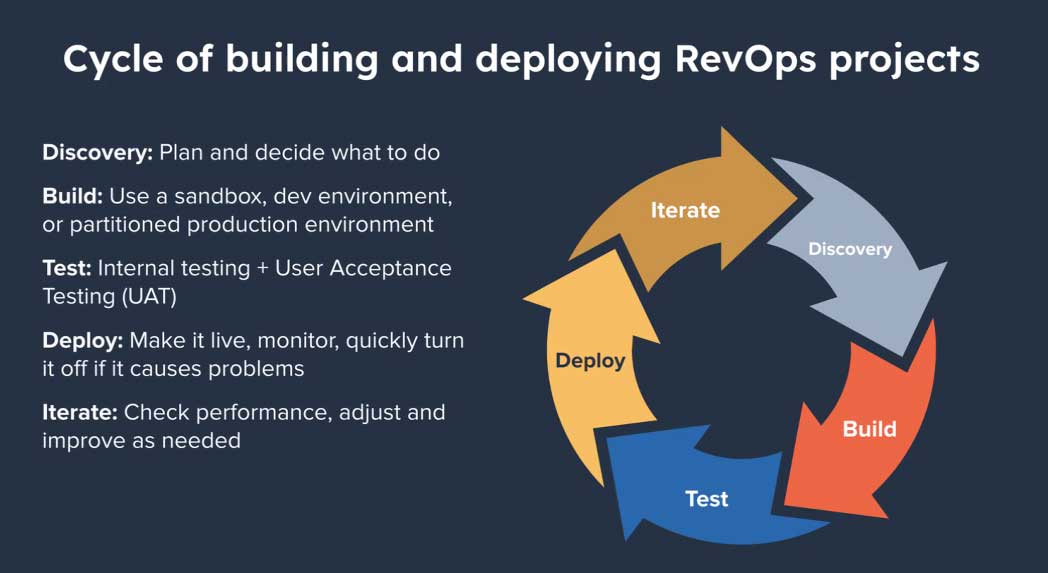
Cycle of building and deploying RevOps projects
The cycle of building and deploying RevOps projects includes stages for discovery, build, test, deploy, and iterate. Slide borrowed from the HubSpot RevOps Bootcamp, led by Jen Bergren, Jacque Turbett, and Connor Jeffers

How to Implement a RevOps Strategy

Adopting a RevOps strategy requires thoughtful planning and execution. The following steps can help guide you in implementing a RevOps framework that works for your organization:

  1. Perform a comprehensive RevOps assessment for your company. Our proprietary grading system identifies areas of opportunity for improvement through the implementation of a RevOps strategy.
  2. Develop detailed process maps of your current to determine where and how your customers may be having negative experiences.
  3. Create future state mapping to optimize processes for maximum efficiency, effectiveness and customer satisfaction.
  4. List your RevOps processes including details of the process, goal, and solution for each initiative.
  5. Conduct an impact and effort analysis to prioritize your projects and include all key stakeholders.
  6. Finally, use your strategic project list and the impact and effort analysis to create a roadmap for implementation of your strategy.

Remember, the goal of RevOps is not just to increase revenue but also to enhance customer satisfaction and loyalty. Therefore, keep a strong focus on customer needs and feedback throughout the process.

Streamline your organization with the power of RevOps.

RevOps is essential for any B2B business that is looking bring in more revenue. The holistic approach to revenue operations brings marketing, sales, and customer success teams together to align their efforts around driving revenue. By supporting data-driven decision-making, streamlining processes, and adapting to changing market conditions – RevOps can help your business increase revenue generation. At its core, RevOps enables businesses to provide top-notch customer experiences, which ultimately leads to increased revenue and business growth. If you haven’t already implemented RevOps, now is the time.


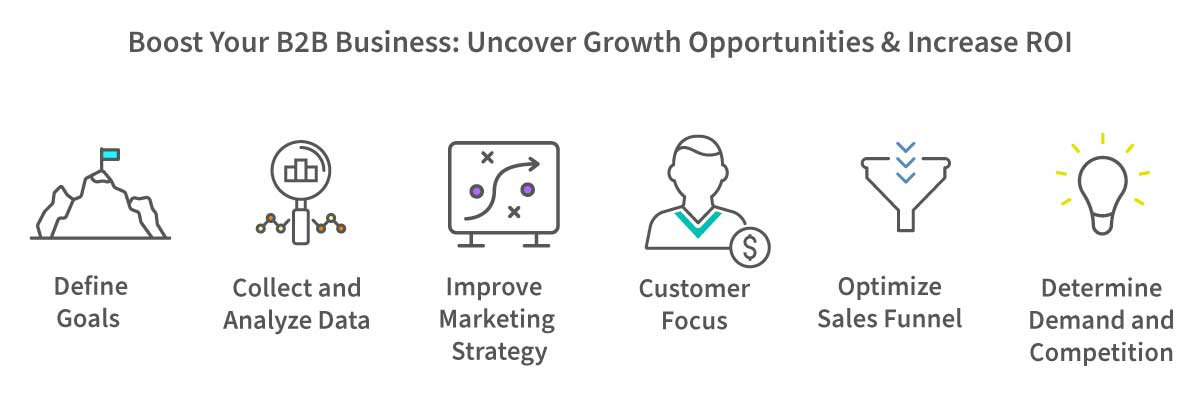
Uncover B2B Growth Opportunities and Increase ROI

For businesses to thrive, growth and return on investment (ROI) must go hand in hand. Unfortunately, many businesses struggle to find the right opportunities to grow while achieving the desired ROI. As a business owner or executive, you know how tough it is to increase ROI without compromising growth or vice versa. But the good news is that you can crack the code by implementing some proven strategies outlined here. We’ll show you how to uncover growth opportunities with increased ROI.

Define Your Growth Goals

Before you can uncover growth opportunities, you must first define your growth goals. This involves identifying what growth means to you, your team, and your business. Clearly define specific, measurable, achievable, relevant, and time-bound (SMART) goals that align with your business objectives. This approach will help you pinpoint areas where your business can grow while measuring the ROI.

To put the concept of SMART goals into context, let’s consider an example. Suppose your business objective is to increase your customer base. A SMART goal aligned with this objective could be: “Increase the number of enterprise-level clients by 20% over the next 6 months through targeted digital marketing campaigns and conversion-optimized sales funnels. Track progress every month using analytics software and adjust strategies as needed based on findings.” This goal is specific (increase enterprise-level clients), measurable (by 20%), achievable (through targeted marketing and optimization), relevant (aligns to grow the customer base), and time-bound (over the next 6 months).

Collect and Analyze Your Data

Data analysis is a critical step in uncovering growth opportunities in business. By analyzing your data, you can identify trends, opportunities, and gaps in your business that you can use to improve your ROI. Data analysis involves gathering, sorting, and analyzing data from various sources such as customer feedback, sales reports, social media, and website analytics, among others.

If your business is currently not tracking B2B data, you can start by implementing a variety of data collection methods. One of the simplest ways is to ask for information directly from your customers or clients through online surveys or feedback forms. You could also consider using social media platforms and professional networking sites, like LinkedIn, to gather information about your target market.

If you’re not currently using a real Customer Relationship Management (CRM) system — or wrestling with spreadsheets as a poor substitute for one — we recommend investing in a commercial-grade tool. Most of our clients use HubSpot, and there are plenty of other options available. CRM systems can track and record every interaction with your clients, giving you valuable insights into their behavior and preferences.

Improve Your Marketing Strategy

Your marketing strategy is the backbone of your growth and ROI. Without an effective marketing strategy, it’s tough to attract new customers, build brand awareness, and generate leads. An effective marketing strategy should include various marketing tactics designed to help you achieve your growth goals while maximizing your ROI. Some marketing strategies include a high-performing website, content marketing, social media marketing, email marketing, pay-per-click, and SEO.

A robust B2B marketing strategy is multi-faceted, with a focus on understanding and meeting the needs of business clients. At its core, it involves a clear value proposition that highlights the unique solutions your products or services provide. It should include targeted marketing efforts such as account-based marketing (ABM), where marketing resources are focused on a specific set of target accounts within a market and employ personalized campaigns designed to resonate with each account. Moreover, it should leverage channels such as LinkedIn for networking and thought leadership, email for direct, personalized communication, and SEO to improve online visibility. Lastly, a good B2B marketing strategy should have a strong emphasis on building relationships, as sales in the B2B sector often rely on establishing trust and demonstrating expertise.

Focus on Customer Experience

Focusing on customer experience (CX) can be a game-changer for businesses seeking growth and higher ROI. In a competitive B2B landscape, providing exceptional customer experience can set you apart from your competitor. Along with personalization and AI, according to this article from Forbes, customer experience is an important trend to watch and leverage.

Start by understanding your customers’ needs, preferences, and pain points. Use this information to personalize your interactions, deliver tailor-made solutions, and exceed customer expectations at every touchpoint. Customer experience isn’t confined to just client servicing; it extends to every stage of the customer journey, from the first interaction to after-sales support. Remember, a satisfied customer can turn into a repeat customer, refer others, and become a loyal advocate for your brand. This not only contributes to business growth but also helps boost ROI, as acquiring a new customer can be up to five times more expensive than retaining an existing one.

Optimize Your Sales Funnel

Your sales funnel is a tool that helps you convert prospects into customers and increase your ROI. However, your sales funnel can only be effective if optimized for maximum efficiency. To optimize your sales funnel, you need to understand your customer journey from awareness to purchase and tailor your sales funnel to meet their needs. This could involve reevaluating your lead generation process, improving your email marketing campaigns, and streamlining your sales process.

Let’s illustrate the optimization of a B2B sales funnel with an example.

Imagine your company manufactures and sells commercial lighting fixtures and you’ve identified that many potential clients abandon the funnel at the consideration stage, after the initial discovery but before requesting a demo. To reduce this drop-off, you could enhance your communication strategies specifically targeting this stage.

For instance, you could create a series of automated emails providing further information, including case studies demonstrating the successful use of your products. In addition, you could offer a personalized webinar to answer potential concerns and demonstrate your product’s value. Moreover, you could optimize your website to feature more customer testimonials and success stories, positioning them prominently on key landing pages.

Remember to track changes in customer behavior using your CRM and analytics tools. Over time, these data-driven adjustments should help to move more prospects from the consideration stage to the decision-making stage, optimizing your sales funnel for better conversion rates and higher ROI.

Assess Market Demand and Competitive Edge

Finally, assessing market demand and competitive edge is another effective way to uncover growth opportunities while increasing ROI. By assessing market demand, you can identify untapped markets, and potential new products or services that can boost your ROI. Assessing your competitive edge can help you identify areas where you can better compete with your rivals while differentiating yourself from the competition.

To illustrate the process of assessing market demand and competitive edge, consider a hypothetical B2B company that provides cybersecurity solutions.

First, the company would conduct market research to identify the demand for its services. This could involve examining industry trends, reviewing reports and studies pertinent to cybersecurity, and surveying potential customers about their cybersecurity needs and concerns.

For instance, the company might find a burgeoning demand for cybersecurity solutions that specifically address remote work vulnerabilities, a segment of the market not adequately catered to by their existing product suite. This insight could lead to developing of a new product tailored to this specific demand, thereby opening up new growth opportunities.

To assess its competitive edge, the company would need to conduct a comprehensive review of its competitors. They could evaluate what services or features their rivals offer, how they price their products, their market share, and their brand reputation. It’s also beneficial to identify any gaps in their offerings or weaknesses in their approach.

Suppose our cybersecurity firm discovers most of its competitors focus heavily on large corporations, leaving small and medium businesses relatively underserved. Recognizing this, they might decide to differentiate themselves by developing affordable, scaled-down cybersecurity solutions tailored for smaller businesses. This unique positioning could provide a competitive edge, helping to captivate a largely untapped market segment and drive growth.

Uncover Growth Opportunities and Increase ROI

By implementing the strategies outlined in this post, you can increase ROI and uncover growth opportunities in your business. Remember, it’s essential to define your goals, analyze your data, optimize your sales funnel, improve your marketing strategy, and assess market demand and competitive edge to achieve your growth objectives. By prioritizing these critical areas in your business, you’ll achieve your growth objectives and increase your ROI.


Contact us for a free consultation and let’s get started.