Why Lighting Exchange-powered agencies are leaving revenue on the table, and what the top performers are doing differently
Most lighting agencies and distributors invest in The Lighting Exchange as a line card solution, and it works well. Your line card is organized, your manufacturers are searchable, and specifiers can find what they’re looking for. Lighting Exchange’s tools are doing exactly what they were designed to do.
The missing layer is a true CRM: the system that gives you control over your customers, insight into what happens after someone engages with your content, and a platform for marketing automation and AI insights. Without it, you’ve got one arm tied behind your back.
Winning Business for Lighting Agencies
The commercial lighting specification channel has a rhythm unlike almost any other B2B industry. The architects, lighting designers, and facilities consultants who drive purchasing decisions aren’t clicking “Buy Now.” They’re building knowledge over months, filing away which agencies represent which manufacturers, and deciding long before a project kicks off, whose phone call they’ll return when it matters.
That means the agencies winning the most business aren’t just the ones with the best line cards. They’re the ones with the best systems for managing, nurturing, and acting on relationships at exactly the right moment in the project cycle.
LEX helps a specifier find your manufacturers. It can’t tell you that a lighting designer at a top hospitality firm downloaded three of your spec sheets last month and hasn’t heard from anyone on your team since.
That’s a relationship waiting to become revenue, but only if you have the system to act on it.
|
|
Download the Free Guide:The Missing Layer: How Lighting Agencies & Distributors Can Turn LEX Engagement Into Real Revenue |

What Lighting Exchange Tells You vs. What You Actually Need to Know
LEX’s analytics are genuinely valuable, with product-level search trends, category engagement, and project gallery traffic. The problem is that this data is anonymous and aggregate. It tells you what is happening across your line card. It doesn’t tell you who is doing it, why they’re looking, or what to do next.
That’s the gap a HubSpot CRM layer closes.
| LEX Tells You | HubSpot Tells You |
|---|---|
| Architectural pendants are trending | ✔️Contact A at Firm B has searched pendants 4 times this month |
| Your hospitality gallery had 200 visits | ✔️ Design firm C visited that gallery before their last two projects |
| Engagement is up 20% this quarter | ✔️ These 8 contacts are showing active buying signals right now |
| A specifier downloaded a spec sheet | ✔️ Here’s their full history and the best time to follow up |
The 5 Revenue Gaps Most Agencies Have Right Now |
|
Gap 1: |
Relationships living in inboxes, not systems. Your best reps have deep relationships, but those relationships live in their email, their phone, and their memory. When someone leaves, the relationship walks out with them. A CRM captures and protects that institutional knowledge so it belongs to the agency, not the individual. |
Gap 2: |
No follow-up system tied to the spec cycle. The lighting spec cycle has a well-defined rhythm: awareness → specification → value engineering → bid → award → install. Most agencies manage touchpoints manually, which means they happen inconsistently or not at all. Automated sequences mapped to that cycle change everything. |
Gap 3: |
Manufacturer reporting stops at engagement. Your manufacturers want to know where their products are being specified, not just viewed. When you can show them a live project pipeline, including deal stage, project size, and expected close, you become an indispensable strategic partner, not just a rep. |
Gap 4: |
No audience segmentation by role. Architects, lighting designers, electrical distributors, and contractors need different messages at different times. Without segmentation, everyone gets the same communication, and most of it lands with the wrong person at the wrong moment. |
Gap 5: |
Marketing spend with no measurable return. How much of your marketing budget is generating actual revenue? For most agencies, this question is genuinely unanswerable. A properly configured HubSpot account connects every campaign, email, and content interaction directly to closed business, so you can invest confidently instead of guessing. |
What the System Looks Like in Practice
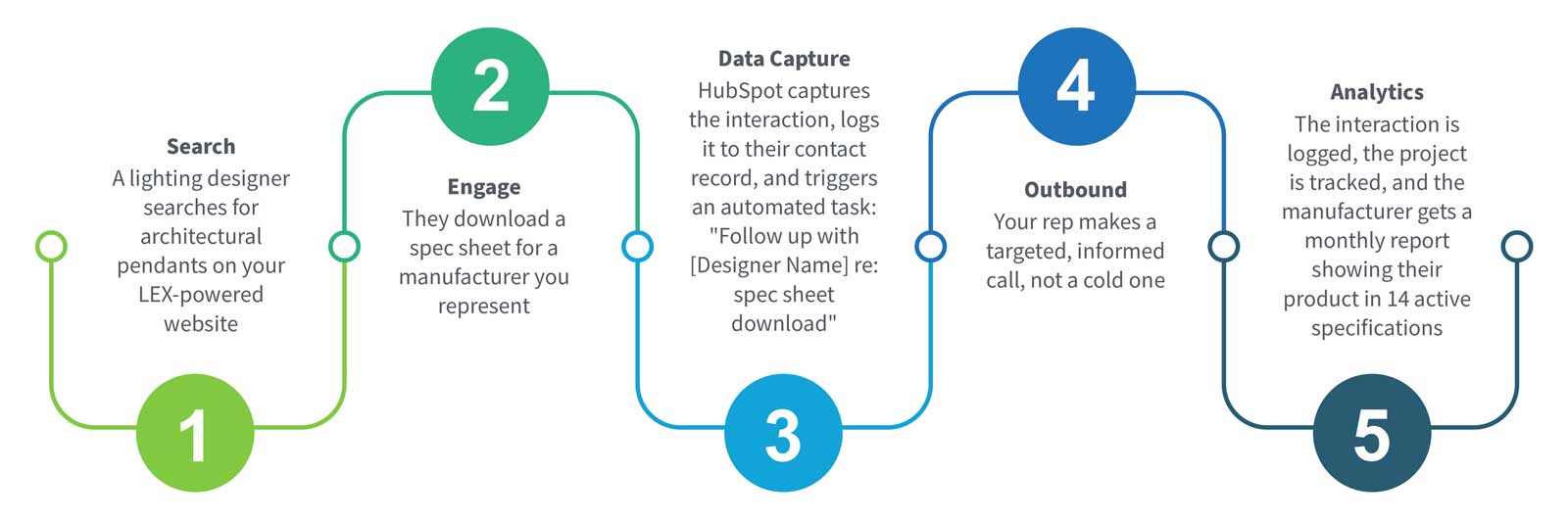
Here’s a simple example of how LEX + HubSpot works:
- A lighting designer searches for architectural pendants on your LEX-powered website and downloads a spec sheet
- HubSpot logs the interaction to their contact record and triggers an automated task: “Follow up with [Designer Name] — pendant spec sheet download, mention [Manufacturer]’s recent hospitality project.”
- Your rep makes a targeted, informed call, not a cold one
- The interaction is logged, the project is tracked, and your manufacturer gets a monthly report showing their product in active specification at 14 firms across your territory
That’s not aspirational. That’s the system that closes the competitive gap and empowers your agency with real customer insight and better client service.
This Is What It Looks Like After Nine Years
We didn’t just design this system on paper. We ran it for nearly a decade.
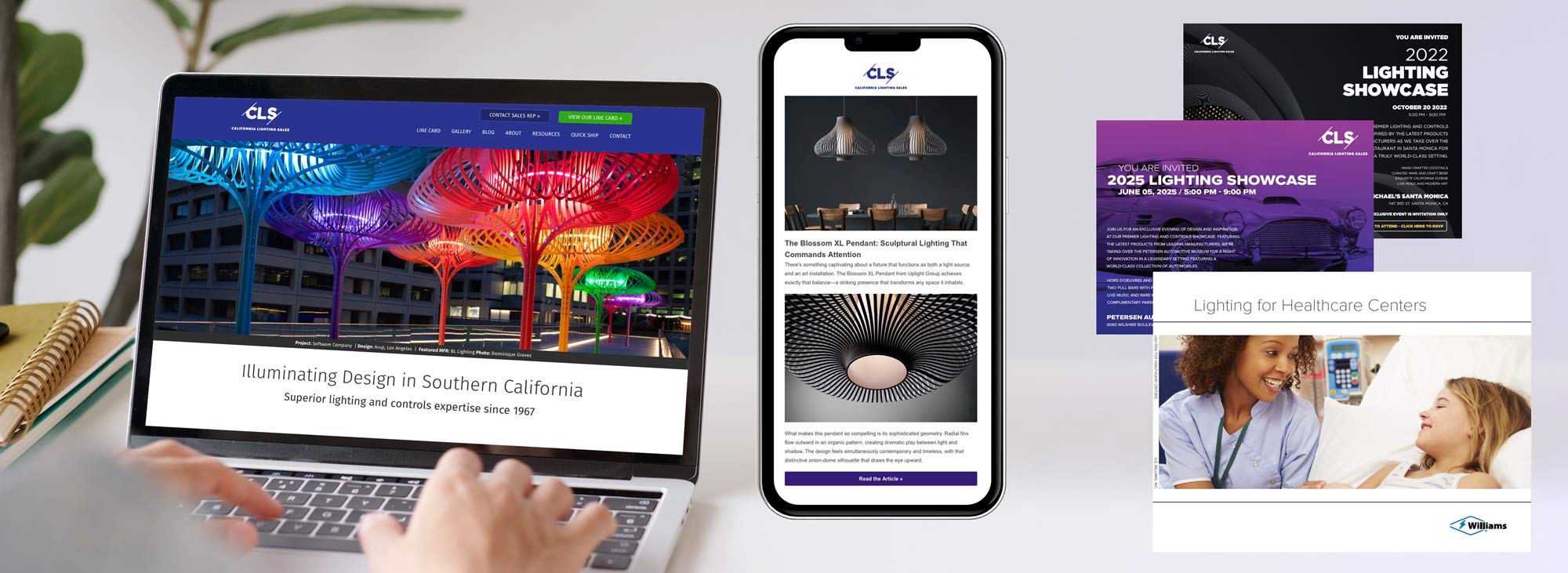
From 2017 to 2026, Bynder Group served as the embedded fractional marketing director for California Lighting Sales — a commercial lighting rep agency serving architects, designers, and engineers throughout Southern California. We built and managed their entire marketing operation: custom website integrated with LEX, HubSpot CRM with 6,500+ segmented contacts, weekly email campaigns, original thought-leadership content, manufacturer promotions, event branding, and sales collateral.
The results after nine years:
- ~46% average email open rate — nearly double the B2B industry benchmark
- 32,000+ website sessions generated over the engagement
- A marketing infrastructure that compounded in value every year it ran
That’s what the system described in this article produces when it’s built right and maintained consistently.
See the full California Lighting Sales case study →
Where to Start
You don’t need to overhaul everything at once. The minimum viable version of this system is three steps:
Step 1: Build a segmented contact database in HubSpot: Architects, lighting designers, distributors, and contractors organized by role and territory.
Step 2: Create three automated sequences: CEU follow-up, sample request follow-up, and post-spec check-in. Just those three will outperform most agencies’ entire marketing efforts.
Step 3: UTM-tag every link that drives traffic into your LEX platform, from emails, social, and paid campaigns, so every specifier who arrives can be attributed to a contact, a company, and eventually a deal in HubSpot.
Start there. Continue to build it over time. The competitive advantage starts on day one.
Related Reading
- Your Reps Aren’t Ignoring Your Line. Your Marketing Is. — The manufacturer’s side of this equation. Once your CRM system identifies which manufacturers are generating the most specifier activity, this is what you should be asking them to provide — and what the best ones already do.
- Why Customer Journey Mapping and RevOps Are Your Most Valuable Marketing Investments — The strategic foundation behind everything described in this post. Here’s how journey mapping and RevOps turn fragmented customer data into a complete picture of where your revenue is being created — and where it’s being lost.
- How AI Customer Agents Work (And When to Use One) — The next layer of the system. AI customer agents can engage specifiers visiting your website in real time — answering product questions, capturing contact information, and logging every interaction directly into HubSpot before a rep ever makes a call.
- Is Your HubSpot Investment Falling Short? — The CRM layer described in this post is only as powerful as the HubSpot setup running it. Here’s how to make sure your platform is actually configured to deliver the pipeline visibility and automation your agency needs.