
Businesses are recognizing the need for seamless integration among marketing, sales, and customer success teams in order to drive a consistent and unified approach towards revenue generation. Furthermore, the advent of advanced data analytics and CRM tools has made the implementation of RevOps more accessible and manageable, thereby contributing to its increasing popularity. Through RevOps, businesses can break down silos, allow for the free flow of information, and foster a shared accountability towards revenue objectives, making it a crucial catalyst for B2B growth.
What is Revenue Operations (RevOps)?
Revenue Operations, commonly referred to as RevOps, is a unified and strategic alignment of all the revenue-generating departments within an organization, including marketing, sales, and customer success teams. This alignment is aimed at breaking down the operational silos to ensure a seamless customer journey from the initial marketing touchpoint, through sales engagement, and ultimately to customer success and retention.
In essence, RevOps empowers sales and marketing teams to operate with increased efficiency, adaptability, and customer-centricity, thereby driving improved business outcomes.
With a data-driven approach at its core, RevOps offers a consolidated view of the entire revenue cycle, enabling teams to make informed decisions, optimize processes, and drive sustainable growth. Implemented effectively, RevOps fosters improved communication, better forecasting, and enhanced operational efficiency within the organization.
Aligning your Teams for Better Collaboration and Results
RevOps aligns your marketing, sales, and customer success teams for better collaboration and results. By sharing insights, data, and processes, these teams can better understand customers’ needs and preferences, improve customer engagement, and effectively close deals. This alignment helps businesses build stronger customer relationships and improve retention, and therefore drive growth.
Supporting Data-Driven Decision-Making
RevOps sets up a data-driven approach to decision-making across all departments, putting your business in a stronger position to capitalize on emerging trends and opportunities. Because RevOps gives you access to real-time data for all customer-facing activities, you’ll be able to use this data to identify new opportunities and implement approaches that work best for your customers. This data-driven approach is invaluable for optimizing all aspects of revenue operations, which ultimately leads to growth.
The Benefits of Adopting a RevOps Strategy for B2B Companies
- Improved Collaboration: RevOps breaks down silos and ensures that all teams are aligned towards common revenue goals, fostering enhanced collaboration and synergy.
- Data-Driven Decisions: With a unified view of all customer-related data, RevOps enables businesses to make informed and timely decisions, driving efficiency and optimization in their revenue operations.
- Increased Operational Efficiency: By streamlining processes and integrating operations across all customer-facing teams, RevOps can significantly enhance operational efficiency.
- Enhanced Customer Experience: A RevOps approach ensures a seamless customer journey from their first interaction to their success and retention, thereby improving the overall customer experience.
- Accurate Forecasting: By leveraging real-time data and shared insights, RevOps allows for more accurate and reliable forecasting, helping businesses plan and strategize effectively.
- Higher Revenue: With better alignment, data-driven decisions, and improved operational efficiency, RevOps ultimately drives increased revenue and growth for B2B companies.
- Customer Retention: RevOps’ focus on customer success leads to improved customer satisfaction and loyalty, leading to higher customer retention rates.
- Greater Adaptability: RevOps empowers organizations to quickly adapt to changes and capitalize on new opportunities, making them more resilient and competitive in the marketplace.
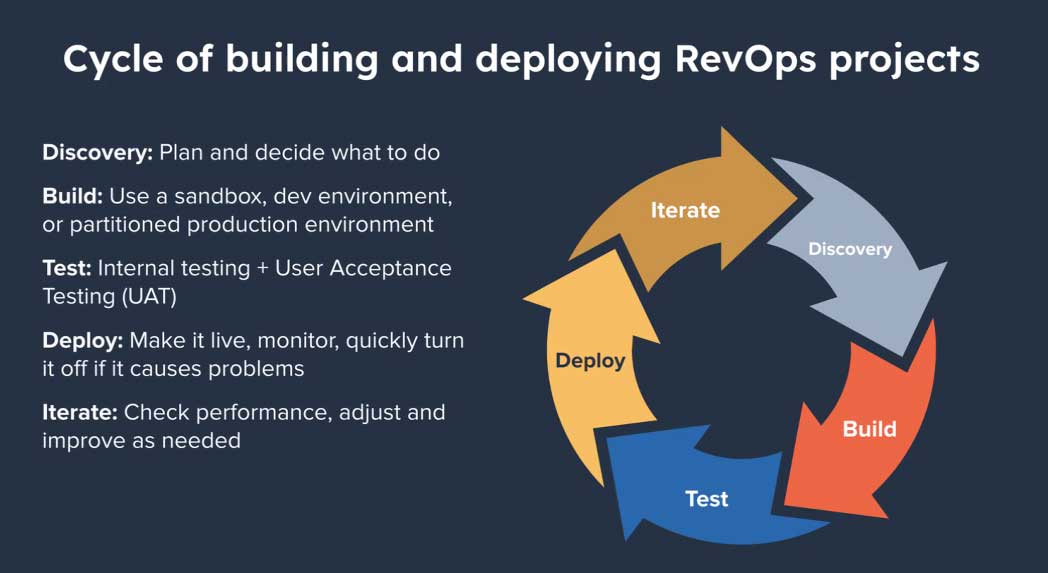
How to Implement a RevOps Strategy
Adopting a RevOps strategy requires thoughtful planning and execution. The following steps can help guide you in implementing a RevOps framework that works for your organization:
- Perform a comprehensive RevOps assessment for your company. Our proprietary grading system identifies areas of opportunity for improvement through the implementation of a RevOps strategy.
- Develop detailed process maps of your current to determine where and how your customers may be having negative experiences.
- Create future state mapping to optimize processes for maximum efficiency, effectiveness and customer satisfaction.
- List your RevOps processes including details of the process, goal, and solution for each initiative.
- Conduct an impact and effort analysis to prioritize your projects and include all key stakeholders.
- Finally, use your strategic project list and the impact and effort analysis to create a roadmap for implementation of your strategy.
Remember, the goal of RevOps is not just to increase revenue but also to enhance customer satisfaction and loyalty. Therefore, keep a strong focus on customer needs and feedback throughout the process.
Streamline your organization with the power of RevOps.
RevOps is essential for any B2B business that is looking bring in more revenue. The holistic approach to revenue operations brings marketing, sales, and customer success teams together to align their efforts around driving revenue. By supporting data-driven decision-making, streamlining processes, and adapting to changing market conditions – RevOps can help your business increase revenue generation. At its core, RevOps enables businesses to provide top-notch customer experiences, which ultimately leads to increased revenue and business growth. If you haven’t already implemented RevOps, now is the time.
Related Reading
- Why Customer Journey Mapping and RevOps Are Your Most Valuable Marketing Investments — The definitive deep-dive into RevOps paired with customer journey mapping — including real-world case studies showing exactly what RevOps delivers in practice.
- The Indispensable Role of Strategic Marketing in B2B Success — RevOps works best when marketing is embedded at the core of the growth strategy. Here’s the research-backed case for why that matters — and how to make it happen.
- 3 CRM Strategies to Boost B2B Customer Lifetime Value — RevOps is the framework. CRM is the engine. Here’s how to use predictive analytics and account health scoring to turn RevOps alignment into measurable lifetime value growth.
- Is Your HubSpot Investment Falling Short? — A RevOps strategy is only as strong as the platform executing it. Here’s how to make sure HubSpot is set up to support the alignment and data-driven decisions RevOps requires.