Most businesses don’t have a spending problem. They have a visibility problem.
Marketing budgets get allocated, campaigns go live, leads come in, and somewhere between the first touchpoint and the closed sale, the wheels come off. Prospects fall through the cracks. Sales and marketing point fingers at each other. Leadership demands better ROI without a clear picture of where value is actually being created or lost.
The solution isn’t to spend more. It’s to understand more. Specifically, it’s to understand the exact journey your customer takes from the moment they discover you to the moment they become a loyal advocate, and to build your operations around that journey. That’s the core promise of customer journey mapping paired with Revenue Operations (RevOps), and it’s the approach Bynder Group has used to drive measurable business growth for companies across industries.
The Gap Between Marketing Spend and Revenue Results
Here’s a frustrating reality that many growing businesses share: they’re generating leads, but can’t trace which marketing efforts are actually driving revenue. They’re running campaigns, but communicating inconsistently across channels. They have data — sometimes too much of it — spread across disconnected systems that don’t talk to each other.
The result is a marketing engine burning fuel without moving the car forward efficiently.
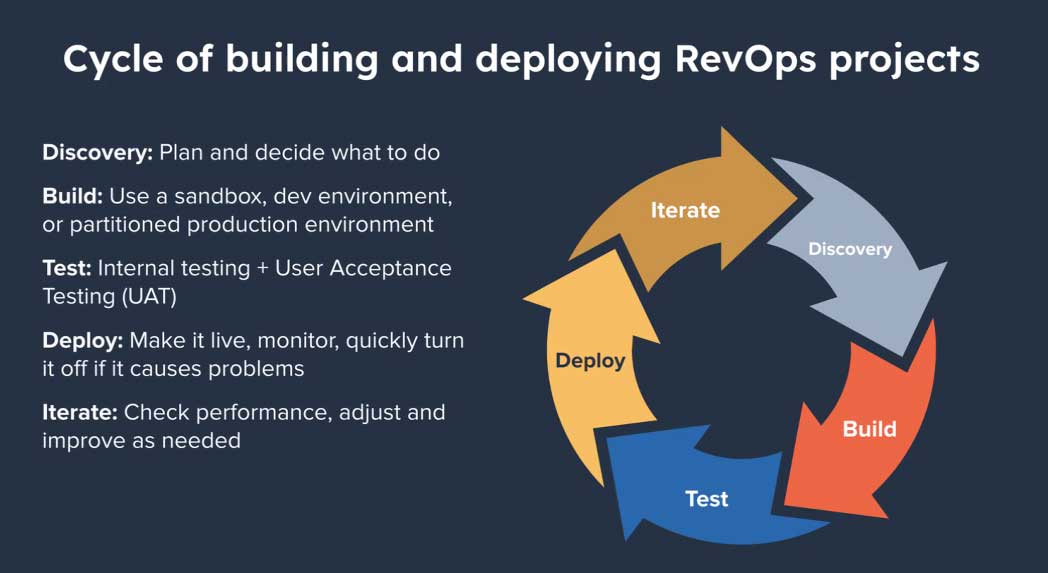
RevOps, short for Revenue Operations , exists to fix this. It’s the strategic alignment of marketing, sales, and customer service teams around a single, unified revenue goal, supported by integrated technology, clean data, and clearly defined processes. When combined with customer journey mapping, which documents every interaction a customer has with your brand from awareness through retention, you get something powerful: a complete picture of where your growth opportunities lie and where your money is being wasted.
Seeing the Full Customer Journey, Not Just Parts of It
One of the most common mistakes growing businesses make is optimizing individual channels in isolation:
- They’ll refine their paid search campaigns without fixing the landing pages those ads point to.
- They’ll invest in email marketing while the booking or checkout process creates friction that cancels out their efforts.
- They’ll pour money into top-of-funnel awareness while a leaky middle-of-funnel quietly erodes conversion rates.
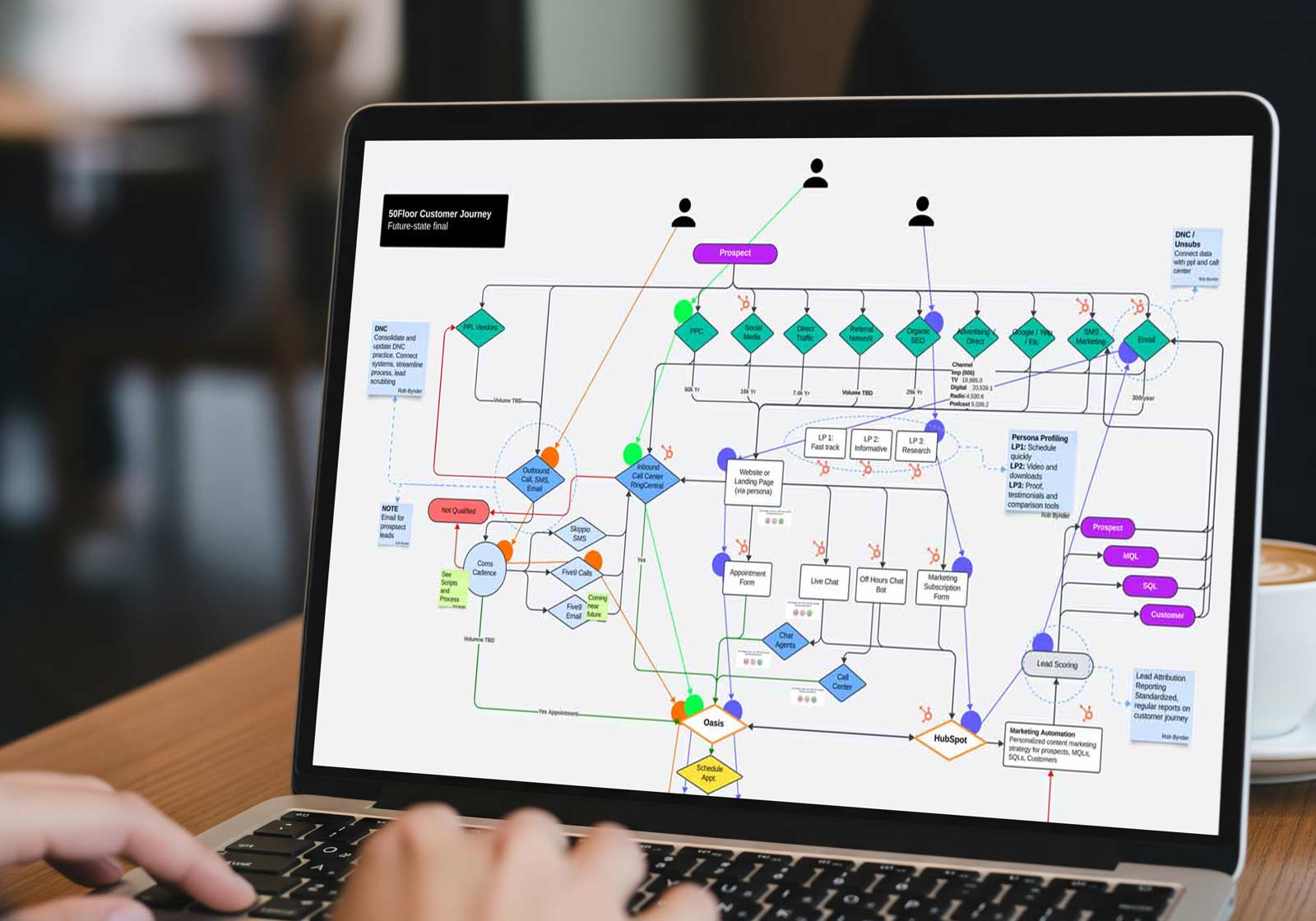
Customer journey mapping forces a different perspective. Instead of looking at marketing touchpoints as isolated activities, it looks at the entire arc of the customer experience, from the first Google search or social media scroll to the post-purchase follow-up, and asks: where are the gaps, the friction points, and the missed opportunities?
This is exactly the process Bynder Group applied for 50Floor, a leading flooring company offering in-home consultations and installation services. Despite a strong service offering, 50Floor faced a fragmented customer experience: no clear attribution of inquiries, duplicated processes, inconsistent communication across touchpoints, and difficulty converting prospects from initial contact into booked home consultations.
By conducting a thorough RevOps and customer journey discovery exercise, including an impartial external channel review, buyer persona development, competitive analysis, stakeholder interviews, and a full technology audit, Bynder Group and strategic partner Secret Source Marketing built a complete picture of where 50Floor’s customer experience was succeeding and where it was costing the company revenue. The result was a strategic roadmap addressing everything from website UX improvements and targeted landing pages to HubSpot re-onboarding and workflow automation. The outcome: streamlined communication between teams, improved appointment conversion rates, reduced operational duplication, and a data-driven measurement framework that allows continuous improvement over time.
The key insight is that none of those improvements would have been identifiable, or prioritizable, without first mapping the entire journey. Without that visibility, 50Floor would have continued investing in pieces of the puzzle while the overall picture remained broken.

RevOps Turns Insight Into Scalable Infrastructure
Mapping the customer journey tells you what needs to change. RevOps determines how to change it in a way that scales with your business.
This distinction matters enormously for companies experiencing or anticipating rapid growth. When a business scales, the cracks in its operational foundation get wider, not smaller. Fragmented data becomes more fragmented. Communication inconsistencies multiply. Revenue leaks that were manageable at one location or one revenue tier become existential problems at ten locations or ten times the volume.
This was the challenge facing Hydration Room, a premium IV therapy and wellness clinic chain that had attracted private equity investment and was positioned for aggressive multi-location expansion. The business had real strengths: strong word-of-mouth referrals that accounted for 38% of new revenue and a loyal customer base. But the PE-backed growth strategy exposed significant operational gaps, including fragmented technology systems with no unified data view, a customer journey with booking friction and inconsistent communications, and a retention rate averaging just 6.5 months with heavy dependence on Q4 performance.
The stakes here were high. Private equity growth targets don’t bend for operational inefficiency. Hydration Room needed not just a diagnosis, but a scalable infrastructure that could support rapid expansion without compounding existing problems.
Bynder Group and Secret Source Marketing delivered a three-phase approach: deep research and analysis (including stakeholder interviews, competitor review, journey mapping, and tech stack audit), strategic design of a future-state customer experience and integrated technology architecture, and a prioritized implementation roadmap tied directly to revenue impact. Deliverables included personalized treatment selection tools to reduce booking friction, multi-channel communication unification, HubSpot CRM integration with their scheduling platform, customer segmentation and scoring frameworks for more personalized marketing, and a formal referral tracking and incentive program.
The projected outcome: a 10%+ annual revenue increase, a unified single source of truth for customer data, improved staff productivity, and the scalable foundation required to hit PE growth targets.
That last point is worth underscoring. The value of RevOps isn’t just operational tidiness, it’s the ability to grow without proportionally growing your problems.
Smart Budget Allocation Starts With Clean Attribution
One of the most direct ways customer journey mapping and RevOps protect and maximize marketing budgets is through attribution. When you know where your customers are coming from, what touchpoints they interact with, and what ultimately drives conversion, you can invest confidently, and cut spending where it isn’t working.
Without this infrastructure, marketing budget allocation is essentially educated guesswork. You might be overspending on a channel that drives awareness but not conversion, while underfunding the touchpoints that actually close deals. You might be losing customers to a post-purchase experience that no one on the marketing team is even aware of, because post-sale customer experience traditionally “belongs” to customer service rather than marketing. RevOps eliminates those silos.
Building for Growth, Not Just for Now
The businesses that scale successfully aren’t always the ones with the biggest budgets or the most aggressive marketing calendars. They’re the ones with the clearest picture of how their customers experience their brand, and the operational infrastructure to deliver that experience consistently at scale.
Customer journey mapping and RevOps aren’t one-time exercises. They create living frameworks that evolve with your business: as you add locations, launch new services, expand into new markets, or respond to shifts in customer behavior. The data you gather, the processes you build, and the technology integrations you establish compound over time, giving your marketing team more to work with and your leadership team more confidence in the decisions they’re making.
These efforts become a foundation that connects customer insight to business operations, and operations to revenue outcomes. That connection is what transforms marketing from a cost center into a growth driver.
If your business is generating leads but losing them somewhere in the funnel, if your teams are working hard but pulling in different directions, or if you’re scaling up and need your systems to scale with you, the most valuable investment you can make right now isn’t more ad spend. It’s clarity about your customer journey and the RevOps infrastructure to act on it.
That’s where growth gets built.
Related Reading
- 3 CRM Strategies to Boost B2B Customer Lifetime Value — How AI-driven CRM insights optimize customer interactions and enhance lifetime value for sustainable growth.
- Mastering B2B Customer Relationship Management: A Strategic Guide — How strategic CRM efforts lead to increased retention rates and sustainable business growth.
- Is Your HubSpot Investment Falling Short? — Why many SMBs aren’t seeing the results they expected from HubSpot, and what to do about it.
- Trust-Based Marketing Strategies for More Profitable Customer Relationships — How building trust with clients drives long-term loyalty, competitive differentiation, and sustainable growth.