Why Customer Journey Mapping and RevOps Are Your Most Valuable Marketing Investments

Most businesses don’t have a spending problem. They have a visibility problem.

Marketing budgets get allocated, campaigns go live, leads come in,  and somewhere between the first touchpoint and the closed sale, the wheels come off. Prospects fall through the cracks. Sales and marketing point fingers at each other. Leadership demands better ROI without a clear picture of where value is actually being created or lost.

The solution isn’t to spend more. It’s to understand more. Specifically, it’s to understand the exact journey your customer takes from the moment they discover you to the moment they become a loyal advocate,  and to build your operations around that journey. That’s the core promise of customer journey mapping paired with Revenue Operations (RevOps), and it’s the approach Bynder Group has used to drive measurable business growth for companies across industries.

The Gap Between Marketing Spend and Revenue Results

Here’s a frustrating reality that many growing businesses share: they’re generating leads, but can’t trace which marketing efforts are actually driving revenue. They’re running campaigns, but communicating inconsistently across channels. They have data — sometimes too much of it — spread across disconnected systems that don’t talk to each other.

The result is a marketing engine burning fuel without moving the car forward efficiently.

RevOps, short for Revenue Operations , exists to fix this. It’s the strategic alignment of marketing, sales, and customer service teams around a single, unified revenue goal, supported by integrated technology, clean data, and clearly defined processes. When combined with customer journey mapping, which documents every interaction a customer has with your brand from awareness through retention, you get something powerful: a complete picture of where your growth opportunities lie and where your money is being wasted.

customer journey mapping

Seeing the Full Customer Journey, Not Just Parts of It

One of the most common mistakes growing businesses make is optimizing individual channels in isolation:

  • They’ll refine their paid search campaigns without fixing the landing pages those ads point to.
  • They’ll invest in email marketing while the booking or checkout process creates friction that cancels out their efforts.
  • They’ll pour money into top-of-funnel awareness while a leaky middle-of-funnel quietly erodes conversion rates.

Customer journey mapping forces a different perspective. Instead of looking at marketing touchpoints as isolated activities, it looks at the entire arc of the customer experience, from the first Google search or social media scroll to the post-purchase follow-up, and asks: where are the gaps, the friction points, and the missed opportunities?

This is exactly the process Bynder Group applied for 50Floor, a leading flooring company offering in-home consultations and installation services. Despite a strong service offering, 50Floor faced a fragmented customer experience: no clear attribution of inquiries, duplicated processes, inconsistent communication across touchpoints, and difficulty converting prospects from initial contact into booked home consultations.

By conducting a thorough RevOps and customer journey discovery exercise, including an impartial external channel review, buyer persona development, competitive analysis, stakeholder interviews, and a full technology audit, Bynder Group and strategic partner Secret Source Marketing built a complete picture of where 50Floor’s customer experience was succeeding and where it was costing the company revenue. The result was a strategic roadmap addressing everything from website UX improvements and targeted landing pages to HubSpot re-onboarding and workflow automation. The outcome: streamlined communication between teams, improved appointment conversion rates, reduced operational duplication, and a data-driven measurement framework that allows continuous improvement over time.

The key insight is that none of those improvements would have been identifiable, or prioritizable, without first mapping the entire journey. Without that visibility, 50Floor would have continued investing in pieces of the puzzle while the overall picture remained broken.

what is RevOps?

RevOps Turns Insight Into Scalable Infrastructure

Mapping the customer journey tells you what needs to change. RevOps determines how to change it in a way that scales with your business.

This distinction matters enormously for companies experiencing or anticipating rapid growth. When a business scales, the cracks in its operational foundation get wider, not smaller. Fragmented data becomes more fragmented. Communication inconsistencies multiply. Revenue leaks that were manageable at one location or one revenue tier become existential problems at ten locations or ten times the volume.

This was the challenge facing Hydration Room, a premium IV therapy and wellness clinic chain that had attracted private equity investment and was positioned for aggressive multi-location expansion. The business had real strengths: strong word-of-mouth referrals that accounted for 38% of new revenue and a loyal customer base. But the PE-backed growth strategy exposed significant operational gaps, including fragmented technology systems with no unified data view, a customer journey with booking friction and inconsistent communications, and a retention rate averaging just 6.5 months with heavy dependence on Q4 performance.

The stakes here were high. Private equity growth targets don’t bend for operational inefficiency. Hydration Room needed not just a diagnosis, but a scalable infrastructure that could support rapid expansion without compounding existing problems.

Bynder Group and Secret Source Marketing delivered a three-phase approach: deep research and analysis (including stakeholder interviews, competitor review, journey mapping, and tech stack audit), strategic design of a future-state customer experience and integrated technology architecture, and a prioritized implementation roadmap tied directly to revenue impact. Deliverables included personalized treatment selection tools to reduce booking friction, multi-channel communication unification, HubSpot CRM integration with their scheduling platform, customer segmentation and scoring frameworks for more personalized marketing, and a formal referral tracking and incentive program.

The projected outcome: a 10%+ annual revenue increase, a unified single source of truth for customer data, improved staff productivity, and the scalable foundation required to hit PE growth targets.

That last point is worth underscoring. The value of RevOps isn’t just operational tidiness, it’s the ability to grow without proportionally growing your problems.

Smart Budget Allocation Starts With Clean Attribution

One of the most direct ways customer journey mapping and RevOps protect and maximize marketing budgets is through attribution. When you know where your customers are coming from, what touchpoints they interact with, and what ultimately drives conversion, you can invest confidently, and cut spending where it isn’t working.

Without this infrastructure, marketing budget allocation is essentially educated guesswork. You might be overspending on a channel that drives awareness but not conversion, while underfunding the touchpoints that actually close deals. You might be losing customers to a post-purchase experience that no one on the marketing team is even aware of, because post-sale customer experience traditionally “belongs” to customer service rather than marketing. RevOps eliminates those silos.

Building for Growth, Not Just for Now

The businesses that scale successfully aren’t always the ones with the biggest budgets or the most aggressive marketing calendars. They’re the ones with the clearest picture of how their customers experience their brand, and the operational infrastructure to deliver that experience consistently at scale.

Customer journey mapping and RevOps aren’t one-time exercises. They create living frameworks that evolve with your business: as you add locations, launch new services, expand into new markets, or respond to shifts in customer behavior. The data you gather, the processes you build, and the technology integrations you establish compound over time, giving your marketing team more to work with and your leadership team more confidence in the decisions they’re making.

These efforts become a foundation that connects customer insight to business operations, and operations to revenue outcomes. That connection is what transforms marketing from a cost center into a growth driver.

If your business is generating leads but losing them somewhere in the funnel, if your teams are working hard but pulling in different directions, or if you’re scaling up and need your systems to scale with you, the most valuable investment you can make right now isn’t more ad spend. It’s clarity about your customer journey and the RevOps infrastructure to act on it.

That’s where growth gets built.

Related Reading


How AI Customer Agents Work (And When to Use One)

Customers today expect fast answers, on their terms. They want to find information themselves, get help without waiting, and move on with their day. When that experience breaks down, whether because a team is stretched thin, a question goes unanswered, or a simple task requires human intervention, it costs you the relationship.

The businesses feeling this most are those where growth has outpaced their support capacity. Teams are buried in repetitive questions, customers are stuck waiting, and no one has the breathing room to focus on work that actually moves the needle.

AI customer agents address all of it at once: faster responses, better self-service options, more consistent experiences, and a support operation that scales without adding headcount.

What Is an AI Customer Agent?

An AI customer agent is software that uses artificial intelligence to handle customer interactions automatically across channels such as web chat, email, and messaging apps. Unlike a basic chatbot that follows a fixed script, an AI customer agent understands context, draws from a knowledge base, and can take action by answering questions, routing tickets, booking meetings, and escalating to a human when needed. It operates 24/7 without a queue, and every interaction is logged directly to your CRM.

What an AI Customer Agent Actually Does

An AI customer agent isn’t a smarter FAQ page or a more sophisticated chatbot. It’s a front-line team member that operates across every channel, including web chat, email, and WhatsApp, around the clock. It surfaces customer context instantly, drafts personalized responses, handles repetitive inquiries autonomously, and knows when to hand off to a human rep.

The distinction matters: this technology works alongside your existing tools and team, not instead of them. Think of it as the difference between hiring an assistant to handle your scheduling versus replacing your entire operations team. The former amplifies what you already have. The latter creates a different set of problems.

The right way to think about AI customer agents is as a force multiplier, one that makes your existing workflows significantly more effective without requiring you to build new systems from scratch.

Traditional Chatbot AI Customer Agent
How it works Follows a fixed script or decision tree Understands natural language and context
Knowledge Your hospitality gallery had 200 visits Draws from a live knowledge base
CRM integration Rarely Native, logs every interaction
Handles new questions No Yes
Available 24/7 Yes Yes
Escalates to humans Basic routing only Intelligent handoff with full context
Learns over time No Yes
Best for Simple, scripted FAQs High-volume, varied customer inquiries


The Business Case in Hard Numbers

For companies that have moved past curiosity and into deployment, the results are consistent and measurable.

Data from companies using AI customer agents alongside HubSpot’s Help Desk shows that 52% of incoming conversations are automatically resolved. This means more than half of inquiries never need to touch a human agent. Ticket closing times improve by 39%, and the cost per resolution is up to 90% lower than human intervention.

Those aren’t marginal gains. For a team handling 500 tickets a week, that’s 260 conversations handled before a rep even opens their inbox. It’s a meaningful shift in how support scales.

The bottom line is that the AI handles the high-volume, repetitive work; humans handle the high-stakes, nuanced work. Both sides of the equation get better.

Value of using ai customer agent

Three Places It Creates the Most Value

1. Customer Support at Scale

This is the most obvious use case, and often the most urgent. Support teams are under pressure from every direction: customer expectations are higher, ticket volume keeps climbing, and headcount budgets are flat. The math doesn’t work without a different approach.

An AI customer agent handles billing questions, password resets, how-to inquiries, and status updates instantly, across time zones, around the clock, without a queue. It draws from your knowledge base and product documentation to give accurate, consistent answers. When a question exceeds its scope, it routes to the right person with full context already captured.

The impact on team morale is worth noting, too. When employees aren’t drowning in repetitive tasks, they show up differently for the complex cases that actually require empathy, judgment, and expertise.

2. Marketing — Turning Traffic Into Pipeline

Many websites have the same problem: they attract traffic but convert it poorly. A visitor lands on a high-intent page, like pricing, product comparison, or case studies, has a specific question, can’t find an immediate answer, and leaves. Traditional forms make them wait hours for a follow-up they may never read.

An AI customer agent acts as a front-of-site concierge. It engages visitors in real time, answers product questions, qualifies intent, and books meetings, all without a human in the loop. Every interaction feeds directly back into your CRM, creating cleaner segmentation and smarter retargeting.

The difference between a form and a real-time conversation isn’t just speed; it’s the quality of the first impression. Buyers who get immediate, relevant answers are fundamentally different from buyers who fill out a form and wait.

3. Sales — Keeping Deals Moving After Hours

Deals stall. A prospect gets excited in a discovery call, has a follow-up question that evening, doesn’t get a response until the next morning, and by then the urgency has faded. Or they’re ready to evaluate pricing, but your rep is in back-to-back meetings. The window closes.

An AI customer agent removes that friction. It answers pricing and product questions when reps are offline, qualifies inbound interest from any channel, and books meetings the moment a prospect is ready. The buying committee, often multiple stakeholders asking different questions at different times, gets immediate value throughout the process, not just during formal touchpoints.

For sales teams, the mental model shift is simple: you’re not replacing rep conversations, you’re ensuring no conversation is lost because no one was available

Overwhelmed worker that would benefit from AI customer agent

Who Gets the Most from This Technology

Like any tool, AI customer agents deliver the most value in specific contexts. The ideal fit tends to look like this: a team handling high volumes of repetitive inquiries, operating with growth pressure that makes adding headcount impractical, and already invested in CRM infrastructure.

Conversely, businesses with very low ticket volume or highly bespoke, complex cases that require deep human judgment may find the ROI harder to realize in the short term, not because the technology doesn’t work, but because the volume needed to justify it isn’t there.

The practical screening question is: “How many tickets per week does your team handle, and what percentage of those are answering the same core questions?” If the answer is hundreds of tickets and a significant majority are repetitive, the math makes sense. If it’s dozens of highly customized cases, the priority should be elsewhere.

The Organizational Readiness Question

Most AI customer agent deployments that underperform share a common cause: the underlying data isn’t ready. An AI is only as useful as the knowledge base it draws from. If your documentation is incomplete, outdated, or scattered across tools, the agent will surface that inconsistency quickly.

The good news is that preparing for deployment often forces the kind of knowledge base cleanup and content organization that teams have been meaning to do for years. Treated as a pre-launch prerequisite, it pays dividends regardless of what the AI does next.

The teams that see the fastest time-to-value are those that start with a narrow, well-defined scope: one department, one channel, one category of inquiry; rather than trying to automate everything at once. They measure resolution rates and customer satisfaction in the first 30 days, iterate on the knowledge base, and expand from there.

Frequently Asked Questions About AI Customer Agents

What types of businesses benefit most from an AI customer agent? Businesses with high volumes of repetitive support questions and limited capacity to scale headcount see the fastest ROI. This includes SaaS companies, e-commerce brands, and B2B service providers handling consistent inbound inquiry volume.

How is an AI customer agent different from a chatbot? A traditional chatbot follows a fixed decision tree;  it can only respond to questions it was explicitly programmed for. An AI customer agent understands natural language, learns from your knowledge base, and can handle questions it hasn’t seen before. It also integrates with your CRM to surface customer history and context in real time.

How long does it take to set up an AI customer agent? Most deployments take two to six weeks, depending on the quality of your existing knowledge base. The more organized your documentation, the faster the setup. Starting with a single channel and a narrow use case significantly shortens time to value.

What happens when the AI can’t answer a question? A well-configured AI customer agent recognizes when a question is outside its scope and routes it to the right human agent, with the full conversation context already captured, so the handoff is seamless.

How much does an AI customer agent cost? Pricing varies by platform and usage volume. Most solutions are priced per resolution or per conversation. HubSpot’s Customer Agent, for example, is priced at approximately $0.50 per resolution, significantly lower than the cost of human-handled tickets.

Will an AI customer agent replace my support team? No. AI customer agents handle repetitive, high-volume inquiries so your team can focus on complex, high-value interactions. The best implementations use AI to increase what each human agent can handle, not to reduce headcount.

From Tool to Competitive Advantage

There’s a useful way to think about where AI customer agents sit relative to your business model. Right now, most of your competitors are either not using them, just getting started, or using them poorly. The gap between “we deployed something” and “we’re getting measurable value” is where the real opportunity lives.

The businesses seeing the most meaningful results aren’t the ones that moved fastest; they’re the most intentional ones. They identified the right use case, prepared their data, set clear success metrics, and treated the first 90 days as a learning phase rather than a finished product.

Speed-to-response used to be a differentiator. Increasingly, it’s a baseline expectation. Customers don’t remember the experience of waiting for an answer; they remember the frustration. An AI customer agent doesn’t just save your team time. It changes the experience your customers have with your brand at every hour of the day.

That’s the actual business case.

Related Reading


HubSpot INBOUND 2025: Welcome to the AI-First Marketing Era

By Rob Bynder

For the first time, INBOUND took place at San Francisco’s Moscone Center, bringing together over 13,000 marketing, sales, and customer success professionals for three days of insights that could redefine business growth. As a design and marketing professional with over 30 years of experience in digital transformation, and a HubSpot agency partner since 2017, I left the conference feeling that HubSpot is undergoing its most significant transformation yet, signaling the start of a new era.

Here’s your executive summary of the future.

Loop marketing

The Great Marketing Reset

CEO Yamini Rangan delivered the harsh truth: traditional inbound marketing is having its going the way of MySpace. Organic traffic as we’ve known it is dying, and traditional inbound marketing strategies are losing their effectiveness in an AI-mediated world.

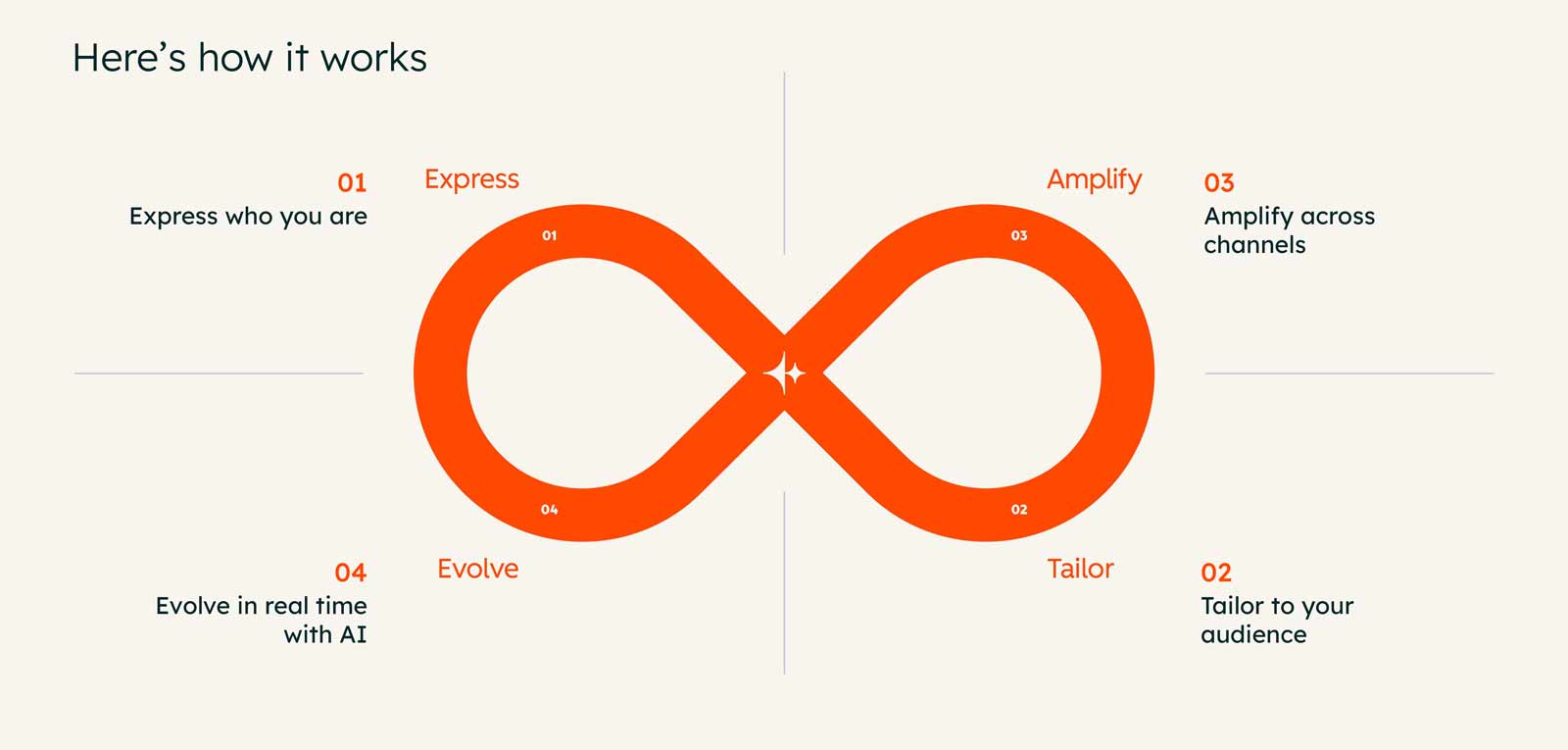
Enter “The Loop“: HubSpot’s evolution beyond inbound marketing. It’s a continuous growth cycle methodology designed for hybrid human-AI teams:

  • Express: Say something worth hearing
  • Tailor: Make it personal (actually personal, not “Dear [First Name]” personal)
  • Amplify: Be everywhere your customers are
  • Evolve: Adapt faster than your competitors can say “pivot”

This represents the most significant shift in growth methodology since HubSpot first coined “inbound marketing” over a decade ago.

HubSpot 2025 Fall Spotlight

200+ Updates That Actually Matter

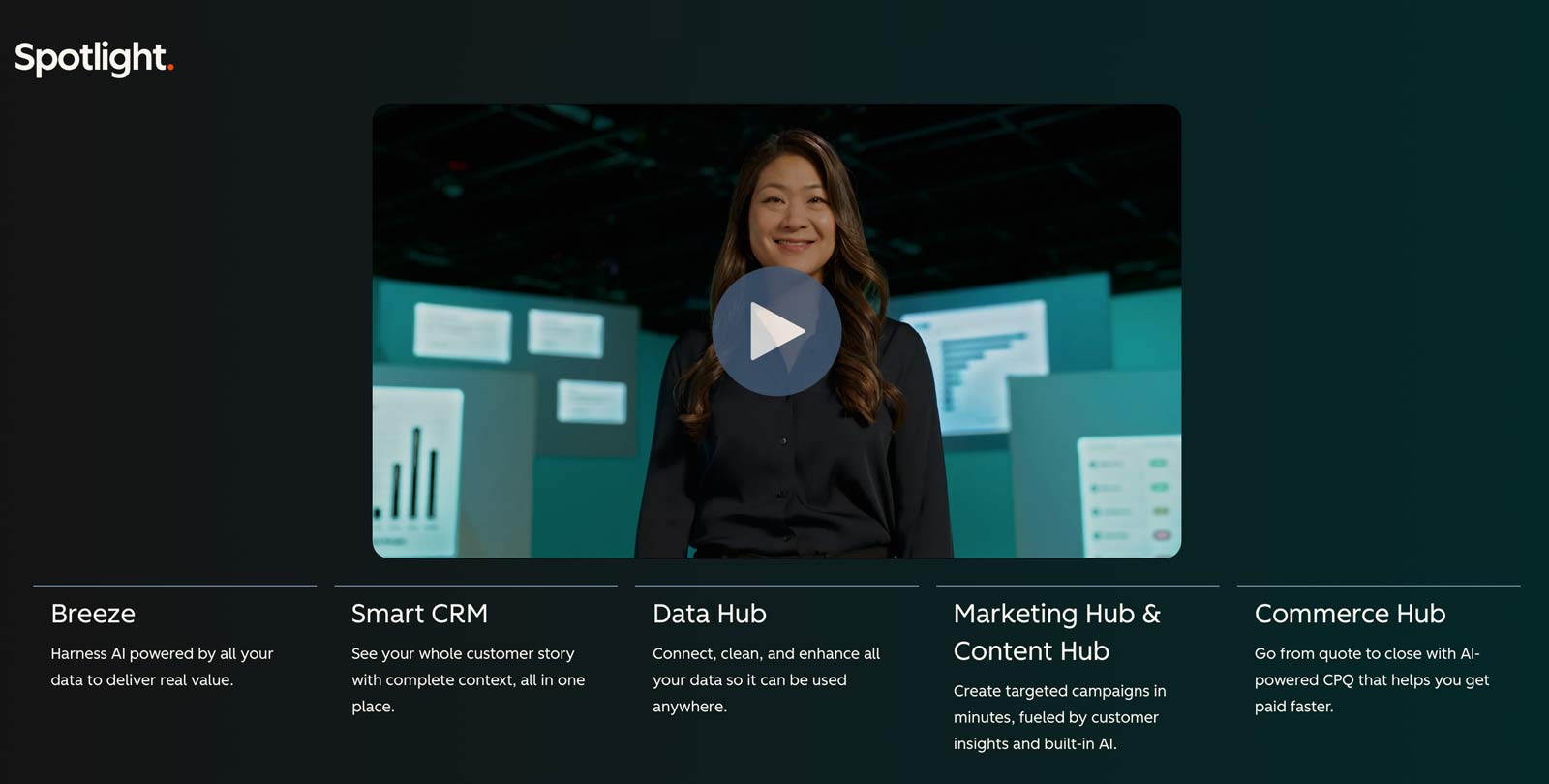
The HubSpot Fall 2025 Spotlight introduced over 200 product updates, the largest release in the company’s history. Three announcements stand out as game-changers for growth-focused organizations:

data hub

Data Hub: Your Crystal Ball, But Real

Most businesses make critical decisions with only 20% of their available data. The rest sits trapped in silos, scattered across systems, or buried in unstructured formats like call transcripts and email conversations.

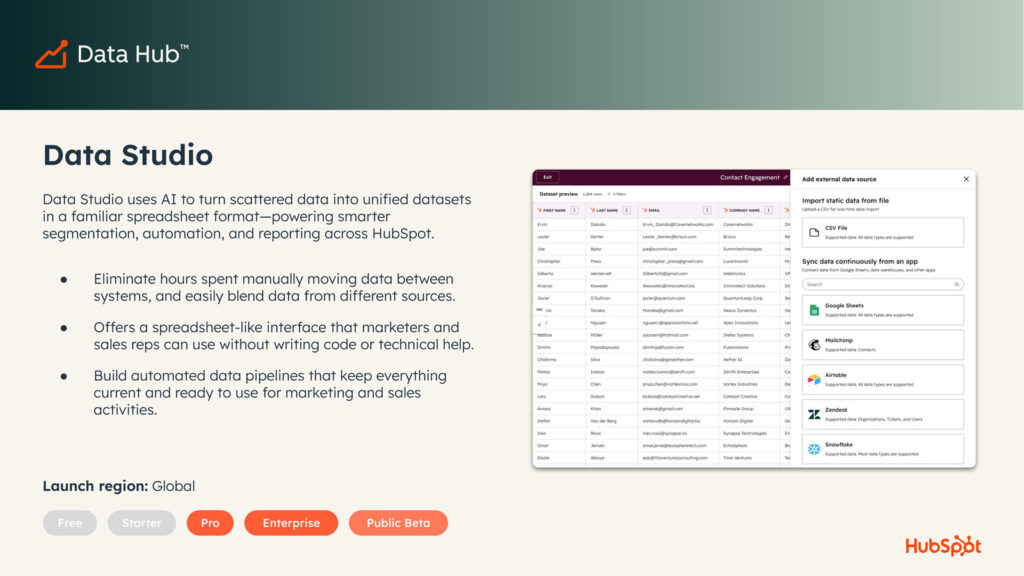
HubSpot’s new Data Hub addresses this challenge directly by consolidating structured, unstructured, and external data sources into a single, unified foundation. Key capabilities include:

  • Data Studio: Connects to warehouses, apps, and files while suggesting data relationships
  • Data Quality: Automates de-duplication, standardization, and gap-filling
  • Smart CRM enhancements: Flexible views, conversational enrichment, and AI-surfaced insights

For businesses struggling with fragmented customer data, this represents a massive competitive advantage. When your AI systems have complete context about customer interactions, they can deliver truly personalized experiences at scale.

hubspot breeze

Breeze Agents: Your New AI Workforce

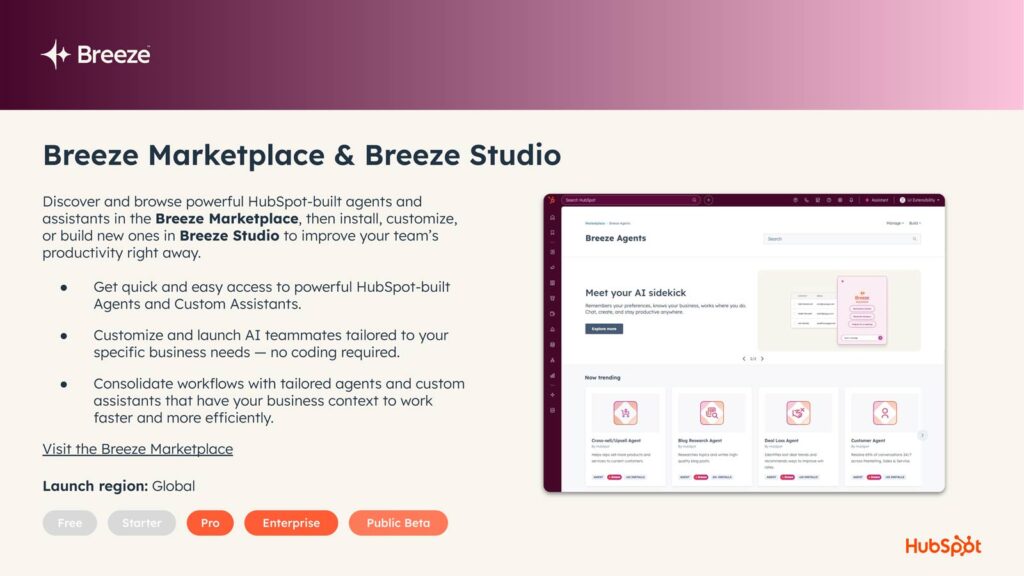
Eighteen new AI agents that don’t just give advice, they do the work. The standouts:

  • Data Agent: Answers complex customer questions instantly (like having a research team that never sleeps)
  • Customer Agent: Resolves half your support tickets automatically (your support team will send thank-you cards)
  • Prospecting Agent: A 24/7 BDR that never gets tired of rejection

These aren’t chatbots—they’re digital employees with access to your entire business context.

hubspot smart crm

Smart CRM: Like a Bespoke Suit for Your Business

HubSpot’s new Smart CRM redefines customer relationship management by integrating cutting-edge AI capabilities designed to streamline business operations and elevate customer experiences.

  • Flexible CRM Views: See your customer data the way your business works to more easily spot trends and act fast.
  • Self-Generating CRM Data: Automatically enriches contact and company records with HubSpot’s proprietary data, AI-driven smart properties, and insights pulled straight from your team’s conversations.
  • Smart Insights: Proactively analyzes CRM data and identifies what’s important, what’s changed, and what to do next.

What This Means for Your Business

The implications of INBOUND 2025 extend far beyond HubSpot users. Here’s how smart business leaders should be thinking about these developments:

1. AI Is Infrastructure, Not a Side Project

The companies that succeed won’t be those with the most AI tools, but those with the smartest hybrid teams where AI multiplies human impact rather than replacing it.

2. Data Unity Is Your Competitive Moat

The businesses thriving in 2025 and beyond will be those that can activate all their customer data, not just the 20% that’s easily accessible. If your organization is still operating with data silos, you’re essentially fighting with one arm tied behind your back.

3. Customer Experience Becomes Conversational

The shift toward AI-mediated buyer journeys means customers increasingly expect conversational, personalized interactions rather than traditional funnel-based experiences. Businesses need to meet customers where they are, with the right message, at the right time, through the right channel.

4. Marketing and Sales Alignment Is Critical

With AI agents handling more routine tasks, human team members can focus on strategy, creativity, and complex relationship building. But this only works when marketing and sales operate from the same data foundation and shared objectives.

The Bottom Line

Exploring the conference with Nick Carlson from Secret Source, we were both struck by how lucky we are for this opportunity to experience such a massive evolution in business, marketing, and communications firsthand. Having experienced the invention of desktop publishing, the rise of the internet, the emergence of social media, and now the rapid growth of AI and automation, it’s clear that innovation is accelerating at an unprecedented pace.

INBOUND 2025 made one thing clear: the businesses that master hybrid human-AI operations will create significant competitive advantages over those that treat AI as an afterthought.

HubSpot’s massive product release provides a glimpse into what’s possible when AI is deeply integrated into every aspect of the customer experience. But tools alone won’t drive success. You need strategy, data discipline, and a commitment to continuous learning.

The Loop isn’t just HubSpot’s new growth playbook. It’s a preview of how all successful businesses will operate in the AI-first era. The question isn’t whether this transformation will happen, but whether your business will adapt and gain a competitive edge.

Colin Jost at Inbound 2025

Plus, Colin Jost killed it in a much-needed break from work with an inspiring and hilarious set about overcoming self-doubt and trusting our ideas to become successful.


Trust-Based Marketing Strategies for More Profitable Customer Relationships

The Trust Factor: How B2B Brands Can Build More Profitable Customer Relationships

Trust is, arguably, the single most valuable currency of successful customer relationships. Trust forms the foundation upon which lasting and profitable customer relationships are built. When customers trust a business, they:

    • Feel more confident in their purchasing decisions
    • Are more likely to become repeat customers
    • Are more inclined to recommend the business to others
    • Are often willing to pay premium prices
    • Tend to be more forgiving when mistakes occur

A strong foundation of trust enhances the customer experience by fostering a sense of reliability and satisfaction, which encourages long-term loyalty and positive engagement. Building trust requires consistency, transparency, delivering on promises, and demonstrating genuine care for customer needs. Once established, trust creates a competitive advantage that’s difficult for competitors to replicate.

trust is the tipping point for customer loyalty

Tipping the Scale: Why Trust Matters in B2B Relationships

The B2B buying journey is fundamentally different from consumer purchases. With higher price points, longer sales cycles, and multiple stakeholders involved in decisions, B2B relationships are inherently built on a deeper level of commitment. When a business chooses your solution, they’re not just buying a product—they’re often investing in a partnership that will impact their operations for years to come.

Research consistently shows the financial impact of trust. According to Edelman’s Trust Barometer, 81% of B2B decision-makers list trust as a crucial factor when making purchasing decisions. Furthermore, trusted B2B relationships lead to 5x more revenue potential over time compared to transactional relationships.

    • Accelerated Sales Cycle – Trust accelerates the sales cycle by reducing the perceived risk associated with major investments. When prospects trust your brand, they spend less time in the consideration phase and move more quickly toward commitment. Even more importantly, trusted relationships generate higher retention rates. In an era when acquiring a new customer costs 5-25 times more than retaining an existing one, cultivating trust becomes a vital economic strategy.
    • Greater Brand Equity – Trust strengthens immediate customer relationships and builds long-term brand equity by fostering loyalty and positive brand perception. This enduring brand equity enhances competitive advantage, promotes consistent revenue, and increases the business’s overall value in the marketplace.
    • Positive Reputation – Furthermore, as consumers become increasingly connected and vocal on social media platforms, a company’s reputation for trustworthiness can significantly impact its ability to attract new customers and retain existing ones. By prioritizing trust in customer relationships, businesses can safeguard their brand image and maintain a positive online presence.
    • Enhanced Customer Experience – Trust is an essential ingredient for creating a positive customer experience. When customers feel that they can rely on a company to deliver what was promised, they are more satisfied with their overall experience. This leads to increased customer satisfaction and loyalty, resulting in repeat business

Components of a Trustworthy B2B Brand

Before diving into specific marketing strategies, it’s important to understand what components make up a trustworthy B2B brand:

    • Consistency across all touchpoints ensures your brand delivers a unified experience, from marketing messages to customer support interactions.
    • Transparency in operations, pricing, and limitations builds credibility. Being honest about what your solution can and cannot do prevents disappointment and establishes realistic expectations.
    • Reliability in meeting deadlines, honoring commitments, and delivering consistent quality demonstrates that your organization can be counted on.
    • Expertise signals to clients that you understand their challenges and can provide valuable solutions based on deep industry knowledge.
    • Client-centricity puts customer needs at the forefront, showing that you genuinely care about solving their problems rather than just making a sale.

Barriers to Trust in B2B Relationships

Several factors can undermine trust in B2B relationships. Understanding these barriers is crucial for addressing them proactively:

    • Industry-specific challenges vary—financial services companies must overcome regulatory concerns, while technology providers may face questions about data security. Each sector has its unique trust hurdles to clear.
    • Digital transformation has changed how trust is built. With fewer face-to-face interactions and more digital touchpoints, B2B companies must find new ways to establish human connections.
    • Market volatility and economic uncertainty can make buyers more cautious and risk-averse, raising the bar for trust requirements before major purchases.
    • Previous negative experiences with similar vendors often create skepticism that new providers must work hard to overcome.

5 Effective Trust-Building Marketing Strategies for B2B Companies

Let’s explore five powerful strategies that B2B companies can implement to build trust through their marketing efforts:


Unisouce Solutions

1. Content Marketing with Educational Focus

True thought leadership comes from putting customer education ahead of promotion. By creating deep, research-backed resources that address your audience’s most pressing challenges, you position your brand as a trusted advisor rather than just another vendor.

This approach works because it demonstrates expertise while simultaneously providing genuine value before asking for anything in return. The key is consistency—maintaining a regular publishing cadence with high-quality information that helps your audience solve real problems.

Real-World Example of Effective Content Marketing

Unisource Solutions exemplifies the art of building customer trust through carefully crafted educational content marketing. Their blog serves as a knowledge hub where they share expert insights on workspace optimization, custom furniture, and ergonomics—topics directly relevant to their target audience’s challenges. By consistently publishing well-researched, educational articles rather than promotional content, Unisource Solutions positions itself as a trusted advisor in the workspace solutions industry. Their commitment to delivering valuable information establishes credibility with potential clients long before the sales conversation begins.

To implement this strategy:

    • Develop cornerstone content pieces that address fundamental industry challenges
    • Create content that answers questions your prospects have at each stage of their buyer journey
    • Invest in original research that provides new insights for your industry
    • Focus on solving problems rather than promoting products
    • Ensure all content features high-quality writing and visually engaging images that are directly relevant to the topic, enhancing both readability and audience engagement.

Giroux Glass

2. Case Studies and Social Proof

In B2B contexts where stakes are high, proof matters more than promises. Detailed case studies that document successful client partnerships with measurable results provide powerful evidence that your solution delivers value.

The most effective case studies go beyond vague testimonials to showcase specific metrics and outcomes. They tell compelling stories of transformation while providing concrete evidence that your solution works in real-world scenarios.

Real-World Example of Effective Use of Case Studies and Social Proof

Giroux Glass masterfully leverages its project portfolio to build customer trust through compelling case studies and social proof. Their extensive portfolio showcases over 45 diverse projects, including high-profile works like SoFi Stadium, Grand Canyon Skywalk, and numerous prestigious commercial buildings, demonstrating their versatility and expertise across different industries. By documenting these impressive achievements with specific metrics and compelling visuals, Giroux Glass establishes credibility that resonates with potential clients seeking a proven partner for complex glazing projects.

To implement this strategy:

    • Document client success with before-and-after metrics
    • Create video testimonials featuring client stakeholders
    • Develop industry-specific case studies that address unique sector challenges
    • Use professional-quality photos and videos to reinforce credibility

hubspot academy trust

3. Clear Value Communication

Clear and honest value communication is key to building trust and helping prospects understand the benefits of your solution. This means highlighting what your product or service offers and how it addresses customer needs, without overpromising or using cliched jargon.

Real-World Example of Value Communication with Clarity

HubSpot excels at building trust by clearly communicating its value through a vast library of free educational resources, tools, and templates. These offerings deliver immediate value to potential customers, even before a purchase is made. By showcasing expertise in addressing marketing and sales challenges, HubSpot establishes credibility and fosters relationships based on genuine value, steering away from purely transactional sales tactics.

To implement this strategy:

    • Clearly articulate the benefits and outcomes customers can expect
    • Use specific metrics and examples to demonstrate the business case for your solution
    • Develop and promote materials such as educational tools, comparison guides, or detailed case studies.

Thought Leadership and Expert Positioning

4. Thought Leadership and Expert Positioning

True thought leadership goes beyond basic content marketing to establish your brand as a visionary in your space. This involves executive participation in industry conversations, publishing original research and data reports, and speaking at major industry events.

The goal is to demonstrate that your organization doesn’t just understand today’s challenges—it’s anticipating tomorrow’s opportunities and preparing clients for future success.

Real-World Example of Expert Positioning

Deloitte regularly publishes comprehensive industry trend reports and forecasts that position them as forward-thinking experts. Their Global Technology Leadership Study and other research initiatives showcase their ability to identify emerging trends and provide strategic guidance.

To implement this strategy:

    • Publish annual industry trend reports and forecasts
    • Secure speaking engagements at major industry conferences
    • Host and participate in webinars, industry organization events, knowledge-sharing sessions, executive roundtables, and thought leadership events.
    • Develop and share proprietary research and insights

Client-Centric Community Building

5. Client-Centric Community Building

Creating platforms for peer-to-peer learning among clients demonstrates a commitment to their success that extends beyond your product or service. Client communities add value by connecting customers with each other, facilitating knowledge sharing, and creating a sense of belonging.

These communities also provide valuable feedback that helps improve your offerings, creating a virtuous cycle of continuous improvement based on client input.

Real-World Example of Client-Centric Community Building

Adobe has built robust user communities and hosts the annual Adobe Summit that brings together customers to share best practices. Their client advisory boards directly influence product roadmaps, demonstrating their commitment to customer-driven innovation.

To implement this strategy:

    • Create online platforms for client networking and knowledge sharing
    • Host user conferences and client summits
    • Develop client advisory boards for product development input
    • Facilitate mentorship programs between experienced and new clients

Measuring Trust-Building Efforts

Trust-building isn’t just a feel-good exercise—it’s a strategic investment that should be measured. Key metrics for tracking trust development include:

    • Net Promoter Score (NPS) and customer satisfaction metrics
    • Client retention rates and expansion revenue
    • Engagement with thought leadership content
    • Referral rates and word-of-mouth business generation
    • Reduction in sales cycle length for new prospects

Regularly gathering feedback on trust perceptions through client surveys and interviews provides qualitative insights to complement these quantitative metrics.

The Path Forward: Making Trust Your Competitive Advantage

In today’s business environment, trust stands as the most enduring competitive advantage for B2B brands amid growing skepticism toward organizations. As decision-makers face an overwhelming barrage of marketing hyperbole, aggressive sales approaches, and inflated promises, authentic, trusted relationships have become the critical factor determining which providers ultimately secure and maintain client partnerships.

The strategies outlined here require genuine commitment—there are no shortcuts to building authentic trust. However, the investment pays dividends in the form of longer client relationships, larger deal sizes, and more predictable revenue streams.

For B2B companies looking to differentiate themselves in crowded markets, focusing on trust-building isn’t just good ethics—it’s good business. By implementing these strategies consistently and authentically, you can transform your brand from just another vendor to a trusted partner in your clients’ success.


Mastering B2B Customer Relationship Management: A Strategic Guide

B2B companies face unique challenges that set them apart from their B2C counterparts. While consumer-focused businesses might close deals in minutes, B2B relationships often span months or years, involving intricate contracts and high-value transactions across manufacturing, technology, and service sectors.

The CRM Revolution in B2B

Modern B2B success hinges on sophisticated customer relationship management (CRM) systems. These tools do more than track sales—they serve as the nerve center for client interactions, market intelligence, and relationship building. However, many organizations struggle to harness their full potential.

Breaking Down the Data Integration Challenge

Consider this scenario: A sales representative prepares for a client meeting, but crucial information is scattered across multiple platforms—pricing history in one system, support tickets in another, and communication logs in various email threads. This fragmentation isn’t just inconvenient—it’s a strategic liability that:

    • Clouds decision-making with incomplete data
    • Creates customer friction through disjointed interactions
    • Hampers team collaboration and efficiency
    • Reduces the accuracy of business forecasting

Three Pillars of Modern B2B Relationship Management

Three Pillars of Modern B2B Relationship Management

1. Smart CRM Implementation

Rather than treating CRM as a simple database, leading B2B companies use it as an intelligence hub that:

    • Automates routine tasks to free up valuable selling time
    • Deploys AI to predict customer needs and spot opportunities
    • Integrates seamlessly with existing business tools
    • Provides real-time insights for agile decision-making

2. Strategic Communication Evolution

Modern B2B relationships thrive on precision communication that:

    • Spans multiple channels while maintaining consistency
    • Delivers personalized insights based on client behavior
    • Anticipates needs through predictive analytics
    • Creates meaningful touchpoints throughout the customer journey

3. Proactive Support Excellence

Transform customer support from a cost center to a growth driver by:

    • Establishing dedicated account management teams
    • Creating feedback loops that drive continuous improvement
    • Offering self-service resources for common inquiries
    • Providing data-driven solutions before problems escalate

The Bottom Line: CRM as a Profit Center

When executed effectively, robust CRM strategies deliver measurable returns including increased customer retention rates. These benefits extend to higher average deal values, shortened sales cycles, improved team productivity, and enhanced market intelligence. As these advantages compound over time, organizations can create a sustainable competitive advantage that becomes increasingly difficult for competitors to replicate. The strategic implementation of comprehensive CRM approaches not only optimizes current business processes but also builds a strong foundation for long-term growth and market differentiation.

Looking Ahead

In an era where business relationships are increasingly digital, mastering CRM isn’t just about managing contacts—it’s about creating a systematic approach to understanding and serving customers better. Companies that invest in these capabilities now position themselves for long-term market leadership.

Related Reading