
Referrals are not a marketing strategy. They’re a reward for good work — and they’re unpredictable, unscalable, and invisible until they slow down. Most architecture firms have built their entire growth model on them anyway.
That model isn’t sustainable, and inevitably, one of three things happens: a key referral source retires, the market softens, or the firm tries to grow beyond what its partner relationships can carry. Suddenly the pipeline that felt reliable for a decade looks fragile.
The work wasn’t the problem. The marketing was never built.
The Referral Network Is an Asset, Not a Strategy
Referrals are the best leads a firm will ever get. High trust, short sales cycles, high close rates. Everyone loves referrals. The problem is treating them as a system.
A referral network is a relationship asset built by individual principals over years of excellent work. It’s not scalable, it’s not transferable, and it’s not visible in any meaningful way until it slows down. When a firm’s growth depends entirely on that network, it’s betting its future on the continued health and activity of a handful of personal relationships. That bet has a time limit.

What Architecture Firm Marketing Usually Looks Like
Walk through the marketing infrastructure of most architecture and landscape architecture firms and you’ll find some version of the same setup:
- A portfolio website built to impress peers and win awards — not to generate leads
- A LinkedIn presence that goes active during slow periods and quiet during busy ones
- An awards and editorial strategy that generates press but no pipeline
- A contact page that serves as the only conversion point on the entire site
- A CRM that either doesn’t exist or hasn’t been opened in six months
None of this is neglect. It’s a predictable outcome when business development has always worked through relationships, and when the principals running the firm are architects first, business owners second.
The problem isn’t that these firms don’t care about marketing. It’s that they’ve never approached it as a strategic and systematic process that can be measured and improved.
The Feast-or-Famine Mechanic
Here’s how it typically plays out:
The firm is busy. Marketing stops. There’s no time, no urgency, and the work is coming in anyway.
The project load lightens. The pipeline looks thin. Panic sets in. Someone updates the website, posts a few project photos, sends a couple of outreach emails. Nothing converts quickly, because marketing doesn’t work on a crisis timeline.
The cycle repeats.
The firms that break this cycle aren’t doing more marketing during the slow periods. They’re doing consistent, systematic marketing all the time, even when they don’t need it. Especially when they don’t need it.
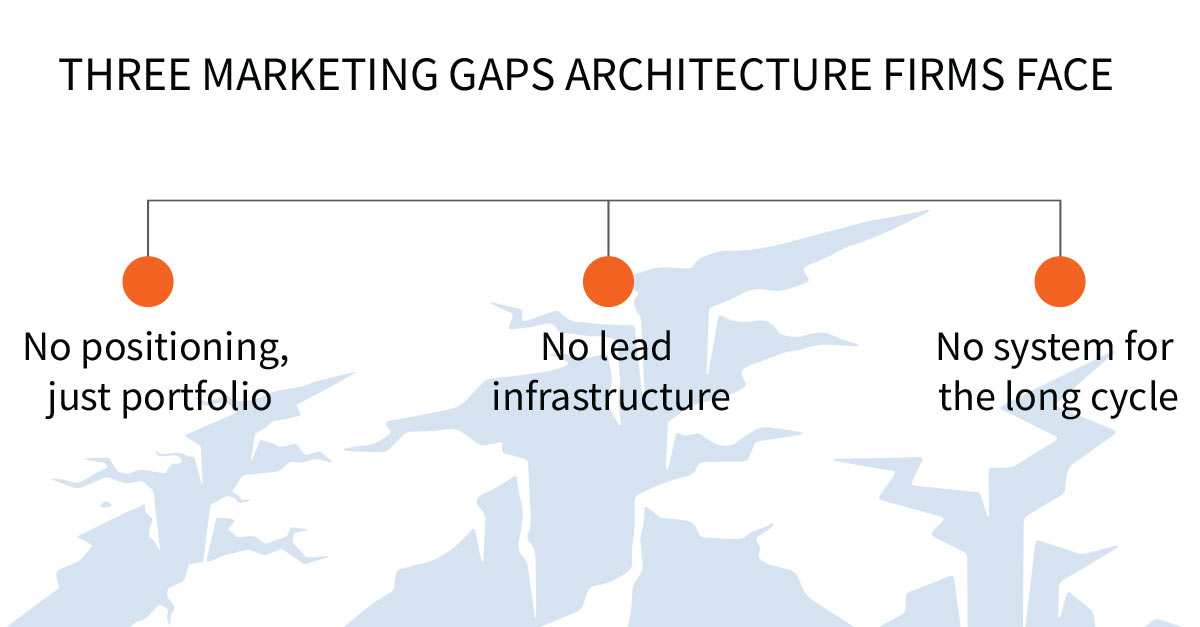
The Three Gaps That Keep Architecture Firms Stuck
1. No positioning, just portfolio
Most architecture firms compete visually. Better photography. More prestigious past clients. Stronger awards record. The problem: every other firm is competing the same way.
The firms that command premium fees and attract the right clients have done something harder — they’ve made a clear claim about who they serve and why their approach is different. Not vague (“we believe design should be beautiful and functional”) but specific (“we specialize in adaptive reuse for commercial real estate developers in secondary markets”).
That kind of positioning closes doors. Most firms are afraid of that. What it actually does is make every door you keep open easier to walk through.
2. No lead infrastructure
A visitor spends twelve minutes on your project portfolio. They read three case studies. They look at the team page.
Then they leave.
You have no idea they were there. You have no way to follow up. You don’t know why they visited. They might have been a viable client, and the website failed to capture any information.
This is not a traffic problem. It’s a conversion infrastructure problem, and it’s one most website redesigns never actually solve. The fix isn’t more visitors. It’s giving the right visitors a reason to connect.
3. No system for the long cycle
A commercial architecture engagement or a significant landscape project can take twelve to twenty-four months from first conversation to signed contract. The relationship has to stay warm across budget cycles, ownership changes, board approvals, and competing priorities.
Most firms manage that with memory and email threads. When the project manager changes, the relationship cools. When the prospect goes quiet for six months, there’s no follow-up mechanism, just hope.
A twelve-month nurture sequence isn’t complicated. But it has to be built into a documented customer journey before the prospect goes quiet, not after.
This Isn’t a Technology Problem
A CRM won’t fix a firm that hasn’t defined who it’s marketing to. A new website won’t generate leads if there’s nothing to capture them. An SEO strategy built on the wrong keywords will attract traffic that never converts.
The sequence matters.
Positioning comes first. Then comes the infrastructure to support it — a website that converts, a CRM that tracks, a content strategy that builds authority in a specific lane. The technology is the execution layer. Strategy is what makes it work.
What Consistent Pipeline Actually Requires
Firms that have solved this problem share a few traits. They’ve made a clear positioning decision and they hold it. They have a website that does business development work when their principals are busy, including tools that engage and qualify visitors automatically. They have a CRM that gives them pipeline visibility, not a spreadsheet, not a folder of business cards. They produce content that demonstrates expertise rather than just displaying work.
And they market consistently, not reactively.
None of this requires a ten-person marketing team. It requires the right infrastructure, built once, running continuously.
