
Signal to Noise: How B2B Marketing Stands Out in a Loud World.

Your marketing content isn’t working the way it used to. Years of AI-generated marketing slop have eroded the trust buyers once had in the companies they do business with.

Traffic might look OK. Open rates may be holding steady. But the space is getting very noisy. Is your marketing even getting heard above the cacophony?

Quick answer: Search is splitting into three separate competitions: traditional SEO, Answer Engine Optimization, and Generative Engine Optimization, and most B2B content is only built for the first one. Buyers also fact-check almost everything AI tells them, and discount anything that traces back to a vendor talking about itself. The fix isn’t more content. It’s content built to name specific numbers, sources, and third-party proof so it survives a skeptical buyer’s fact-check, and structured so AI systems can cite it accurately.

The Space Got Loud, and Trust Has Eroded

AI is now standard equipment in B2B content production. 95% of B2B marketers use it somewhere in their content workflow, according to the Content Marketing Institute’s 2026 research. Buyers can no longer tell AI-written copy from human-written copy, so they’ve stopped trying and started distrusting both.

This is the real cause of the plateau you’re seeing. Inbound marketing’s original premise was simple: helpful content earns trust, and trust earns pipeline. That concept paid off when helpful content was scarce. It isn’t scarce anymore. It’s everywhere, and most of it looks, sounds, and reads the same.

SEO Stopped Being the Only Game

51% of B2B software buyers now start their research more often in an AI chatbot than in Google, up from 29% less than a year earlier, according to G2’s 2026 Answer Economy report. Ask ChatGPT or Perplexity a buying question, and it synthesizes an answer on the spot. The buyer may never click through at all, and if they do, it’s often later in the funnel than it used to be. AI is absorbing the early research clicks; what reaches your site increasingly skews toward buyers who are closer to a decision.

This isn’t the classic SEO game with a new name. We now have multiple measurement channels running simultaneously:

  • SEO competes for a ranking position.
  • Answer Engine Optimization (AEO) competes for the single answer slot inside an AI response.
  • Generative Engine Optimization (GEO) competes for a place in the pool of sources an AI cites while building that answer.

Three different games, three different scoreboards, and most B2B content teams are still only playing the first one.
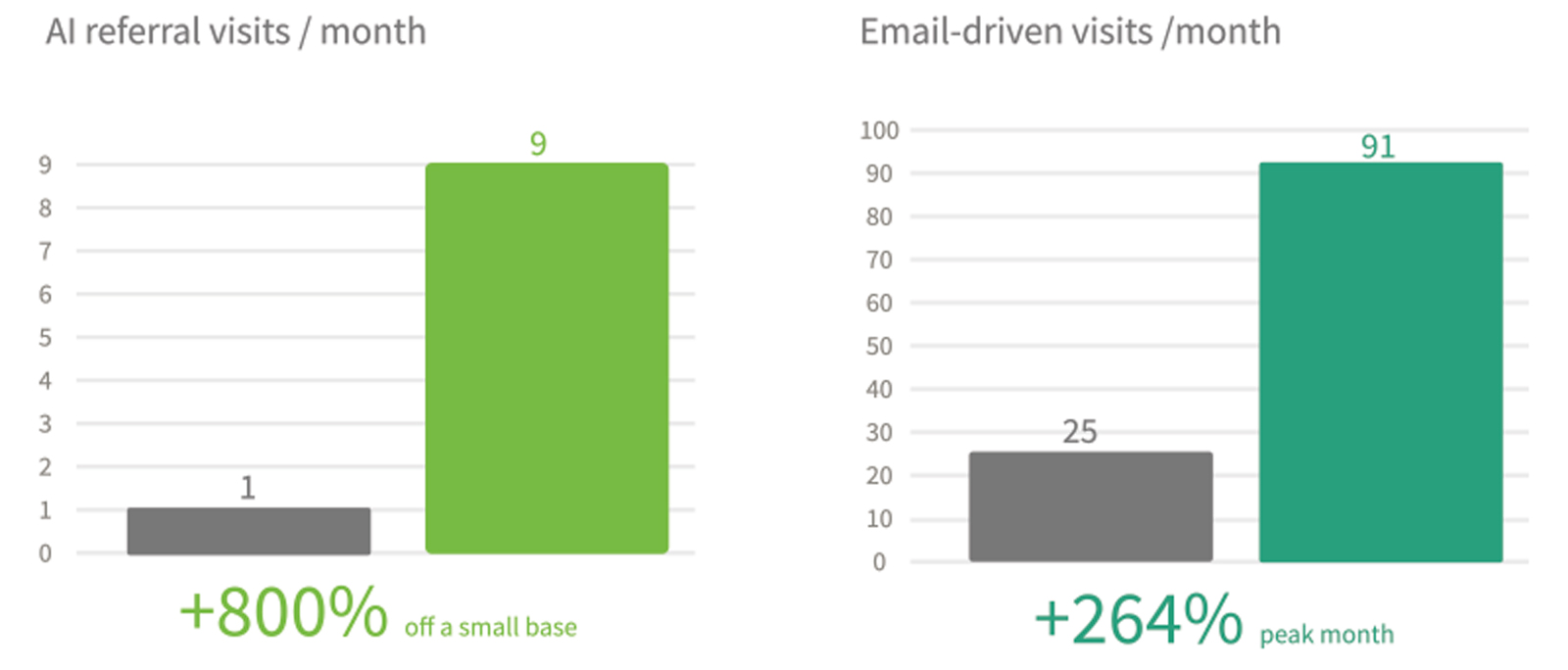
Bar chart showing a B2B client's fastest-growing traffic channels from January to July: AI referral visits grew from 1 to 9 per month, an 800% increase, and email-driven blog visits grew from 25 to 91 per month, a 264% increase.

Trust Is the New Bottleneck, and Here Is the Real Data That Shows It

Buyers have stopped blindly trusting the research they do in AI. According to TrustRadius’s 2026 B2B Buying Disconnect Report, a survey of 1,862 buyers and 444 vendors, 94% of B2B buyers who use AI to research a purchase fact-check what it tells them, and 47% say they trust online content less than they did a year ago, up from 39% the year before. In the same report’s ranking of the resources buyers consult most, vendor-published content comes in last.

We watched this shift play out with real numbers this year, working with a B2B client in a physical-goods industry. Between January and July, blog visits arriving from AI referral sources grew from 1 to 9 a month, an 800% increase off a small base. It’s still a sliver of total traffic. But it’s the fastest-growing channel this client has, and it’s growing for the reason the industry data predicts: AI systems are starting to cite them as a source, not just crawl them as a page.

The bigger signal showed up in a channel most teams stop watching once it’s “working”: email. Email-driven blog visits for this client grew 264% between January and July and ended the period ahead of social, referral, and AI traffic combined. That’s not about gaining a new audience. It’s about trust in their brand. Every one of those visits came from someone who had already opted in, someone who trusted the sender before they ever clicked.

Organic and direct traffic still made up the majority of this client’s blog visits this year, and that’s worth stating plainly instead of explaining away: brand equity still works. But it mostly works on people who already know your name. It says very little about whether you’re reaching the buyer who doesn’t know you exist yet, which is exactly the moment AEO and GEO are built to win.

Five Shifts to Make Before Your Next Content Strategy Review

Marketing content is still valuable, maybe more than ever. But it’s no longer enough to write for people and optimize for SEO alone. AI retrieval systems parse a page the way a skeptical buyer does: looking for a clear, named claim, not a slow build-up, and looking for evidence that traces back to somewhere other than the vendor talking about itself. This matters because buyers discount an AI answer the moment they trace its source back to vendor-controlled content alone, and vendor-published material already ranks dead last among the sources they say they trust. Content built to be cited has to assume that trace-back will happen.

  1. Write for verification, not volume. Write for clarity and prioritize content that names a number, a mechanism, or a named example. AI systems and skeptical buyers discount vague claims the same way: they skip past them.
  2. Structure content to be quoted. Put a direct, plain-language answer in the first sentence or two of a section, not the last. Name the specific entity, the client, the metric, the source, instead of writing around it. That’s the passage most likely to get lifted into an AI-generated response.
  3. Pair every claim with proof that isn’t you. A number you publish about yourself reads as marketing copy. The same number, sourced to an independent report or attributed to a named client, reads as evidence. Build content around what can be verified outside your own site, not just what you assert on it.
  4. Feed your nurture stream before you feed the algorithm. This client’s numbers make the case on their own: a smaller, trusted list outperformed a wider, cold one. Segment by persona and customer journey stage, and distribute the content via your email marketing platform.
  5. Design your site for the buyer who’s already arrived at a decision, not the one still browsing. AI is absorbing the early, informational clicks. The traffic that still reaches your site skews toward people closer to buying, so the page they land on should assume that, with pricing, proof, and next steps close at hand instead of another layer of introductory content.

The Playbook Didn’t Break. The Old Scoreboard Did.

None of this means marketing is dead. In fact, that’s far from the truth. It means stop measuring the effectiveness of your marketing against a scoreboard that stopped counting the way you think it does. The teams pulling ahead right now aren’t producing more content than everyone else. They’re producing content built to survive being checked.


Bynder Group Clinches the Prestigious 2023 Fall Clutch Global Award

We are thrilled to announce that Bynder Group has been recognized as an award winner for two Clutch awards: the 2023 Clutch Global Award and the 2023 Clutch Champion Award. These prestigious distinctions testify to our unwavering commitment to providing exceptional value and services to our clients.

Bynder Group Clutch Global

2023 Global Award

Honorees for the Global Award are selected based on industry expertise and ability to deliver, scores that are calculated based on the client feedback from thousands of reviews published on Clutch. For the sixth consecutive year, Clutch has honored its top B2B companies with the Global Award designation.

Bynder Group is thrilled to have received the prestigious 2023 Fall Clutch Global Award. This recognition serves as a testament to the exceptional work we have delivered to our clients throughout the year, as attested by their reviews on Clutch. We take immense pride in being recognized as industry leaders in marketing strategy, digital strategy, content marketing, email marketing, and web design on a global scale. The Clutch Global Awards truly showcase the finest in B2B services worldwide.

Bynder Group Clutch Champion Award

2023 Champion Award

Clutch Champions is a prestigious accolade presented to the top 10% of Clutch Global winners. This distinguished recognition celebrates business service providers worldwide for their unrivaled industry expertise and remarkable ability to deliver exceptional results in comparison to their counterparts.

Bynder Group was included among the 2023 Fall Clutch Champions due to having acquired new, verified client reviews within the past six months. This award recognizes Bynder Group as a top-rated leader in marketing strategy, digital strategy, content marketing, email marketing, and web design spaces based on our clients’ satisfaction and high-quality service ratings.

Pursuit of Excellence

We are proud that Bynder Group holds a stellar 5-star rating on Clutch. This rating is a direct reflection of our dedicated efforts and the trust our clients place in us. It highlights our unwavering commitment to providing top-tier customer service and our ability to deliver solutions that create real value for our clients. We are sincerely grateful to our esteemed clients for their generous reviews and feedback, which have been instrumental in helping us achieve this recognition.

About Clutch

Clutch, a leading B2B ratings, and reviews platform is known for its meticulous selection process when awarding companies. Recognition from Clutch is therefore an acknowledgment of a company’s dedication, hard work, and ability to deliver unparalleled services.


How to Use AI Writing Tools to Help with Marketing Content

Artificial intelligence (AI) has become an integral component of modern marketing and website copywriting. AI writing tools like Jasper and Writesonic are helping businesses create content in new ways. As of this writing, the technology is starting to appear integrated into other tools that many of us are already using for marketing, including Grammarly’s GrammarlyGO, and HubSpot’s ChatSpot.

AI writing tools are capable of producing quality marketing content quickly and efficiently, but getting the most out of these tools requires a learning curve, experimentation, research, and good editing skills.

What Are AI Writing Tools?

AI has been around for decades, long before AI writing tools were developed. Today, AI is used in many different fields, from healthcare and finance to security and military applications. Business and marketing software has long included AI for features like chatbots, automation, product recommendations, and more.

Lately, generative AI has exploded, including AI writing tools. These are computer programs that leverage AI-driven natural language processing (NLP) algorithms and are designed to assist writers in creating written content (obviously). They use natural language processing and machine learning algorithms to understand context, generate ideas, analyze data, and refine drafts. AI writing tools can help marketing writers create content more efficiently and effectively by generating ideas, expanding on concepts, editing bad grammar, and suggesting improvements to word choice.

How To Use AI Writing Tools for Marketing

At Bynder Group, we use AI writing tools to help create content for our clients and ourselves more quickly and efficiently. While AI has proven helpful in saving time, it also requires some skill and experience in understanding how to get the best output.

One of the biggest drawbacks of using AI for marketing content is the risk of producing low-quality content. AI writing tools can often produce copy that is repetitive or does not accurately reflect the company’s brand and tone. Additionally, AI tools are not (yet) able to capture subtle nuances in language, which may lead to misunderstandings or misinterpretations.

To ensure quality content, it is important to spend time refining the output of AI writing tools with careful editing before publishing. Additionally, setting clear guidelines on topics and brand language can help steer AI copywriting in the right direction.

Tips For Getting the Most Out of Generative AI Software for Marketing

Using AI Writing Tools for Website Copy

AI writing tools can be useful for creating website copy, such as product descriptions, customer reviews, and landing pages. They can be used to quickly generate a first draft of content without having to spend hours researching and crafting each sentence by hand. This saves time allowing businesses—particularly those with limited budgets—to focus their resources on other equally important tasks. What’s more, when used properly these tools can help ensure consistency across all of your website’s pages by ensuring that each page follows the same style guide and tone of voice.

Using AI Writing Tools for Marketing Copy

AI writing tools can also be used for creating marketing copy, such as email newsletters and social media posts. These tools make it easier for businesses to craft engaging, personalized messages and help generate new ideas for content. For example, users can feed their customer data into an AI tool which will then generate personalized emails tailored to each customer’s needs and interests. When used in tandem with a CRM and marketing platform like HubSpot, the results are genuinely compelling.

Using AI Writing Tools for Content Idea Generation

Using AI writing tools to generate blog ideas can be a great way to quickly come up with creative and interesting topics. By feeding data into the AI writing tool, such as current events and industry news, as well as keyword phrases related to your topic of choice, you can quickly generate lists of new topics.

Using AI Writing Tools for SEO and Content Strategy

By feeding in relevant keyword phrases, AI writing tools can suggest topics likely to rank highly on search engine results pages (SERPs). Additionally, these tools can be used to generate new versions of existing content, keeping it fresh and helping to ensure that it performs well for search.

Writer Assist vs. Auto-Pilot

Using AI writing tools for marketing content has the potential to revolutionize how businesses produce copy and reach their audience. However, it is important to remember that AI is still in its early stages, and it can take time to master the tools and ensure quality output. AI writing tools should be used with great care and as part of a larger marketing strategy which includes other methods of generating original content ideas and engaging customers. With proper use and careful editing, these tools can be handy for creating engaging content that resonates with your audience.

Make the Most of Your AI Writing Tools with These Best Practices:

  • Edit, edit, edit: Ensure your brand’s voice and style are present.
  • Proofread (and edit more): Don’t hit “publish” without proofreading and editing your copy.
  • Enhance: Don’t rely only on AI-generated copy; balance it with human-written content.
  • Verify: Make sure you take a close look at and correct any content that may be biased, offensive, misleading, or just wrong, especially facts and statistics.

Pipeline Generation

Pipeline generation is the lifeblood of most companies. A high-performing pipeline aligns sales and marketing efforts and clarifies available opportunities to maximize potential. When done well, the pipeline flows full with prospects that are a good match. Good match prospects have a higher close rate because the service matches the client’s needs. Likewise, good-match customers and clients see better results with their service providers because values and cultures are aligned. 

pipeline generation bootcamp

Bynder Group director Rob Bynder recently completed the Pipeline Generation Bootcamp, an immersive 6-week program provided by HubSpot Academy designed to teach HubSpot partners and customers the first parts of the inbound sales process. The experience was highly informative and a perfect blend of education, inspiration, and motivation. 

Instructors for this cohort included Trygve Olsen, Keith Gutierrez, and Debbie Akintonde, all HubSpot Certified Trainers. Also on hand to share knowledge and enliven the group was Dan Tyre, Sales Director at HubSpot, who pioneered the concept of alignment between sales and marketing known as “Smarketing.” 

Align Marketing and Sales

Businesses that bridge the gap between marketing and sales see better results using this more strategic approach to client acquisition and growth.

While some of the tasks associated with pipeline generation are outbound practices, the spirit of the inbound methodology is the foundation of inbound sales. The goal is to be helpful and respectful rather than pushy, aggressive, or “salesy.” Providing value to customers through helpfulness encourages trust and enhances rapport. 

The program covered all elements of implementing effective connect calls, including:

  • How to identify good fit leads
  • How to speak and what to say
  • How to use voicemail and how to coordinate email
  • How and why to leverage video
  • How to address objections

The training included workbooks, presentations, access to numerous additional resources, and real-life role-playing, where we could practice the techniques on each other in break-out rooms. Practice and role-playing are highly encouraged and provide a valuable process for working out the kinks. Also covered was the use of conversational pauses and listening techniques like “chin-strokes” and open-ended questions to encourage more and better communication.

What’s the Upshot? 

Bynder Group provides expert guidance on web strategy, design, marketing, and HubSpot CRM for our B2B clients. With the knowledge gained from training programs like the Pipeline Generation Bootcamp, we further provide our clients with additional insight into the skills, techniques, and best practices of high-quality pipeline generation. When used with HubSpot’s powerful marketing, sales, and operations tools, our clients see better results and higher ROI from their efforts.


Rob Bynder Featured on Agency Connect Video Podcast

Agency Connect is a video podcast hosted by Sunir Shah, CEO of AppBind, and produced by the Clounds Software Association. The show covers a range topics related to the working partnerships between agencies and cloud software companies.

Rob Bynder, found and president of Bynder Group was featured on the March 3, 2022 episode. In it, Rob shares insights into marketing agency life and how Bynder Group relies on key strategic partnerships to provide more value to clients and more efficiency to processes.

The Cloud Software Association is the network of partnership leaders building the market for SaaS and cloud software distribution.

AppBind is a subscription manager for digital agencies.


Bynder Group Becomes HubSpot Platinum Agency Partner

This year, 2022, marks our twentieth year of business. During the past couple of decades, we’ve seen this industry change dramatically and have evolved with it.

Since becoming a Certified HubSpot Agency Partner in 2017, our clients have benefited from our deep experience in marketing and web design, along with access to expert services for the world’s leading digital marketing and sales platform.

Now, we’ve leveled up and have been awarded Hubspot Platinum Agency Partner status!

HubSpot’s Certified Agency Partner Tier Program

What is it and why does it matter? HubSpot’s Certified Agency Partner Tier Program acknowledges agency partners who execute digital marketing services to the highest standard.

As a HubSpot Certified Platinum Agency Partner, we have met stringent business criteria in providing expert services to our clients. This means not only does Bynder Group execute these services to exceptionally high standards, but we’re also actively engaged with our clients in using this platform on a daily basis.

This milestone underscores our commitment to our clients’ success by demonstrating greater mastery of this powerful business platform. It is another example of our agency’s expanding scope and ability to empower our clients with the tools necessary to compete with greater success.

“Bynder Group impresses us with their ability to consistently provide stellar results for their clients,” says Matt White, HubSpot Partner Channel Manager. “It’s no wonder that their client retention and referrals are so high. Twenty years of experience has provided them with the vision and leadership skills that HubSpot truly values in our partner agencies.”


quickstart marketing roadmap compassQuickstart Marketing Roadmap: Simple, Strategic, and Customized

Our Quickstart Marketing Roadmap is a customized marketing plan for your business. Get the clarity and vision your need to grow your business and elevate your brand. Get started now »


Why HubSpot Platinum Agency Partner Status Matters To Our Clients

Achieving HubSpot Platinum Certified Agency Partner status reinforces our dedication to helping our clients scale and grow. We lead every engagement with energy, creativity, and accountability. Our areas of focus and HubSpot certification are inbound methodology, inbound marketing, growth-driven web design, CRM, inbound sales, and more.