Demand Generation and Lead Generation for B2B Marketing

Demand Generation and Lead Generation: A Symbiotic Relationship for Success

Both demand generation and lead generation are critical for a successful B2B marketing strategy, but they serve different purposes and require distinct approaches.

Demand generation is a holistic marketing approach to create awareness and interest in a company’s products or services. This is accomplished through a variety of tactics, including content marketing, events, and social media campaigns. The goal is to attract potential customers, build relationships, and increase brand awareness, ultimately creating demand for their products or services.

Lead generation is a subset of demand generation, focused on capturing interest in a product or service to develop a sales pipeline. Tactics often include lead-capturing activities like form fill-outs, subscriptions, or registrations. Here, the goal is to convert an interested potential buyer into a lead, who can then be nurtured through the sales process.

In essence, demand generation creates a desire for your products or services, and lead generation capitalizes on this interest by converting prospects into leads for your sales team. The two strategies work hand in hand, establishing a strong foundation for a successful sales and marketing funnel.

Demand Generation

Demand generation is invaluable for businesses because it increases brand visibility while also stimulating interest in products or services. It initiates the customer’s journey, drawing them into the marketing funnel and paving the way for lead generation and conversion. Demand generation helps companies stand out in a crowded market, fostering consumer trust and loyalty through consistent and impactful interactions.

As noted by Gartner, an industry leader in digital market insights, a well-executed B2B demand generation strategy can drive the creation of sales-ready leads and accelerate revenue growth, thereby demonstrating its significant contribution to a company’s success.

How Deman Generation Improves Valuable Organic Traffic

Demand generation can significantly affect organic traffic, driving more visitors to your website through non-paid search results. A well-thought-out demand generation strategy can boost your organic ranking on search engines by improving your website’s credibility and relevance.

Content plays a critical role in this process. High-quality, valuable content tailored to the needs of your audience is more likely to be shared, increasing your website’s visibility and opportunities for backlinks — two factors that search engines consider when ranking websites.

Furthermore, another aspect of demand generation — SEO (Search Engine Optimization) — directly contributes to improving your organic ranking. By optimizing your content with relevant keywords and phrases that your target audience is likely to search for, you not only make your content more discoverable but also increase the chances of attracting more qualified prospects.

In essence, effective demand generation strategies can enhance your organic traffic by making your website more visible and relevant to your target audience — a critical aspect of expanding your reach and ultimately converting prospects into leads.

Remember that demand generation is a long-term strategy, not a one-time campaign. It requires consistent effort and adjustment over time to adapt to changes in market conditions and your audience’s evolving needs.

Examples of Demand Generation Tactics

  1. Content Marketing: Producing high-quality, relevant content is a powerful way to attract potential customers. This can range from blog posts, whitepapers, and eBooks, to webinars and podcasts. Content marketing positions your company as an industry leader while simultaneously addressing your target audience’s pain points and needs.
  2. Email Marketing: Personalized email campaigns targeting segmented market lists can effectively keep potential customers engaged and nurture their interest in the company’s products or services. An effective email marketing strategy helps maintain top-of-mind awareness among potential buyers and encourages them to take the next step in their buyer’s journey.
  3. Social Media Campaigns: By leveraging the power of social media platforms, businesses can amplify their reach and engage with a wider audience. Regular posting of engaging content, coupled with paid advertisements targeted towards a specific demographic, can stimulate interest and create a buzz around the company’s offerings.

Lead Generation

The primary objective of lead generation is to convert interested potential buyers into leads, who can then be nurtured through the sales process. According to HubSpot’s 2023 Marketing Strategy & Trends Report, lead generation is the 3rd most important metric used when measuring the effectiveness of content marketing strategies.

In digital marketing, the process usually begins when a visitor clicks on a call-to-action (CTA) on either owned or paid media. This CTA leads them to a landing page, which includes a form used to collect the visitor’s information. Once the visitor fills out and submits the form, they are then led to a thank you page.

As with demand generation, lead generation should be thought of as a long-term and continuous process. Regular evaluation and adjustment of your lead generation strategies are necessary to keep up with evolving consumer behaviors and market trends. Remember that the more effectively you can attract targeted leads, the higher the chance of converting them into paying customers.

Successful Lead Generation Starts with Pipeline Generation

Creating a robust lead generation strategy requires systematic planning and implementation. Pipeline generation plays a vital role in bolstering lead generation efforts. It refers to the process of identifying and qualifying prospects that could potentially become leads. This proactive approach helps to streamline lead generation, as it ensures that only high-quality, relevant prospects are targeted, thereby increasing the conversion rate.

Furthermore, it facilitates nurturing strategies, as you can create personalized content based on the specific needs and interests of the prospects in your pipeline. In essence, a robust pipeline generation strategy can significantly enhance the effectiveness and efficiency of your lead generation, ultimately driving more revenue for your business.

Examples of Lead Generation Tactics

  1. Webinars: Hosting interactive webinars is a great way to generate leads. These online seminars offer valuable insights on industry-related topics. Attendees usually sign up in advance, providing their contact information, which makes webinars an excellent tool for collecting high-quality leads.
  2. SEO: By optimizing your website and content for search engines, you can attract more visitors. Using keywords that your target audience is searching for can help increase visibility. Visitors who find your content valuable might be willing to provide their contact information, and hence, can be converted into leads.
  3. Lead Magnets: Offering lead magnets like eBooks, free trials, or software downloads can be an effective lead generation tactic. In exchange for the free resource, potential customers provide their contact information, which can be used for further engagement and lead nurturing.

Key Takeaways for Effective Demand Generation and Lead Generation

Demand and lead generation are critical components of an effective marketing strategy. They involve meticulous planning, execution, and evaluation to ensure you’re reaching the right audience with the right message at the right time. Remember that these strategies are not static, and require continuous optimization based on market trends and customer behavior. By leveraging tools and tactics such as content marketing, social media campaigns, email marketing, webinars, and SEO, you can effectively generate demand, attract high-quality leads, and ultimately drive growth for your business.

Related Reading


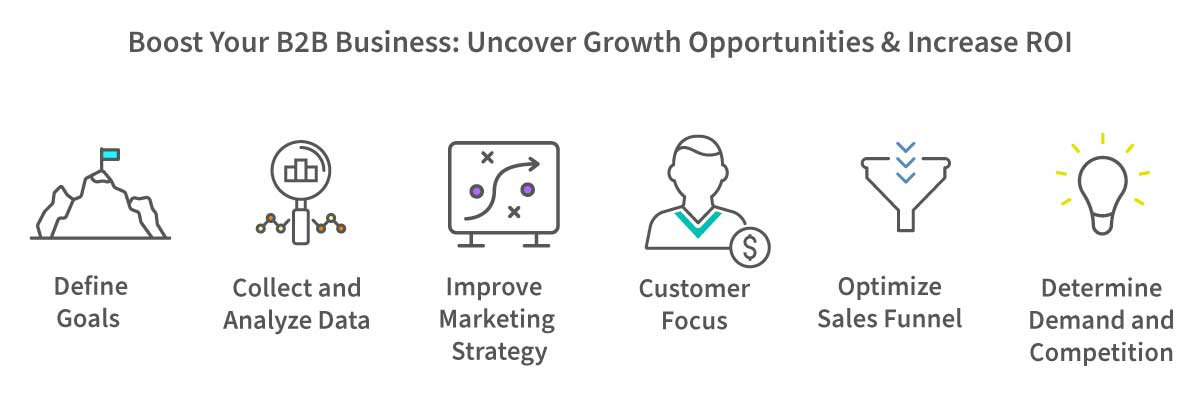
Uncover B2B Growth Opportunities and Increase ROI

For businesses to thrive, growth and return on investment (ROI) must go hand in hand. Unfortunately, many businesses struggle to find the right opportunities to grow while achieving the desired ROI. As a business owner or executive, you know how tough it is to increase ROI without compromising growth or vice versa. But the good news is that you can crack the code by implementing some proven strategies outlined here. We’ll show you how to uncover growth opportunities with increased ROI.

Define Your Growth Goals

Before you can uncover growth opportunities, you must first define your growth goals. This involves identifying what growth means to you, your team, and your business. Clearly define specific, measurable, achievable, relevant, and time-bound (SMART) goals that align with your business objectives. This approach will help you pinpoint areas where your business can grow while measuring the ROI.

To put the concept of SMART goals into context, let’s consider an example. Suppose your business objective is to increase your customer base. A SMART goal aligned with this objective could be: “Increase the number of enterprise-level clients by 20% over the next 6 months through targeted digital marketing campaigns and conversion-optimized sales funnels. Track progress every month using analytics software and adjust strategies as needed based on findings.” This goal is specific (increase enterprise-level clients), measurable (by 20%), achievable (through targeted marketing and optimization), relevant (aligns to grow the customer base), and time-bound (over the next 6 months).

Collect and Analyze Your Data

Data analysis is a critical step in uncovering growth opportunities in business. By analyzing your data, you can identify trends, opportunities, and gaps in your business that you can use to improve your ROI. Data analysis involves gathering, sorting, and analyzing data from various sources such as customer feedback, sales reports, social media, and website analytics, among others.

If your business is currently not tracking B2B data, you can start by implementing a variety of data collection methods. One of the simplest ways is to ask for information directly from your customers or clients through online surveys or feedback forms. You could also consider using social media platforms and professional networking sites, like LinkedIn, to gather information about your target market.

If you’re not currently using a real Customer Relationship Management (CRM) system — or wrestling with spreadsheets as a poor substitute for one — we recommend investing in a commercial-grade tool. Most of our clients use HubSpot, and there are plenty of other options available. CRM systems can track and record every interaction with your clients, giving you valuable insights into their behavior and preferences.

Improve Your Marketing Strategy

Your marketing strategy is the backbone of your growth and ROI. Without an effective marketing strategy, it’s tough to attract new customers, build brand awareness, and generate leads. An effective marketing strategy should include various marketing tactics designed to help you achieve your growth goals while maximizing your ROI. Some marketing strategies include a high-performing website, content marketing, social media marketing, email marketing, pay-per-click, and SEO.

A robust B2B marketing strategy is multi-faceted, with a focus on understanding and meeting the needs of business clients. At its core, it involves a clear value proposition that highlights the unique solutions your products or services provide. It should include targeted marketing efforts such as account-based marketing (ABM), where marketing resources are focused on a specific set of target accounts within a market and employ personalized campaigns designed to resonate with each account. Moreover, it should leverage channels such as LinkedIn for networking and thought leadership, email for direct, personalized communication, and SEO to improve online visibility. Lastly, a good B2B marketing strategy should have a strong emphasis on building relationships, as sales in the B2B sector often rely on establishing trust and demonstrating expertise.

Focus on Customer Experience

Focusing on customer experience (CX) can be a game-changer for businesses seeking growth and higher ROI. In a competitive B2B landscape, providing exceptional customer experience can set you apart from your competitor. Along with personalization and AI, according to this article from Forbes, customer experience is an important trend to watch and leverage.

Start by understanding your customers’ needs, preferences, and pain points. Use this information to personalize your interactions, deliver tailor-made solutions, and exceed customer expectations at every touchpoint. Customer experience isn’t confined to just client servicing; it extends to every stage of the customer journey, from the first interaction to after-sales support. Remember, a satisfied customer can turn into a repeat customer, refer others, and become a loyal advocate for your brand. This not only contributes to business growth but also helps boost ROI, as acquiring a new customer can be up to five times more expensive than retaining an existing one.

Optimize Your Sales Funnel

Your sales funnel is a tool that helps you convert prospects into customers and increase your ROI. However, your sales funnel can only be effective if optimized for maximum efficiency. To optimize your sales funnel, you need to understand your customer journey from awareness to purchase and tailor your sales funnel to meet their needs. This could involve reevaluating your lead generation process, improving your email marketing campaigns, and streamlining your sales process.

Let’s illustrate the optimization of a B2B sales funnel with an example.

Imagine your company manufactures and sells commercial lighting fixtures and you’ve identified that many potential clients abandon the funnel at the consideration stage, after the initial discovery but before requesting a demo. To reduce this drop-off, you could enhance your communication strategies specifically targeting this stage.

For instance, you could create a series of automated emails providing further information, including case studies demonstrating the successful use of your products. In addition, you could offer a personalized webinar to answer potential concerns and demonstrate your product’s value. Moreover, you could optimize your website to feature more customer testimonials and success stories, positioning them prominently on key landing pages.

Remember to track changes in customer behavior using your CRM and analytics tools. Over time, these data-driven adjustments should help to move more prospects from the consideration stage to the decision-making stage, optimizing your sales funnel for better conversion rates and higher ROI.

Assess Market Demand and Competitive Edge

Finally, assessing market demand and competitive edge is another effective way to uncover growth opportunities while increasing ROI. By assessing market demand, you can identify untapped markets, and potential new products or services that can boost your ROI. Assessing your competitive edge can help you identify areas where you can better compete with your rivals while differentiating yourself from the competition.

To illustrate the process of assessing market demand and competitive edge, consider a hypothetical B2B company that provides cybersecurity solutions.

First, the company would conduct market research to identify the demand for its services. This could involve examining industry trends, reviewing reports and studies pertinent to cybersecurity, and surveying potential customers about their cybersecurity needs and concerns.

For instance, the company might find a burgeoning demand for cybersecurity solutions that specifically address remote work vulnerabilities, a segment of the market not adequately catered to by their existing product suite. This insight could lead to developing of a new product tailored to this specific demand, thereby opening up new growth opportunities.

To assess its competitive edge, the company would need to conduct a comprehensive review of its competitors. They could evaluate what services or features their rivals offer, how they price their products, their market share, and their brand reputation. It’s also beneficial to identify any gaps in their offerings or weaknesses in their approach.

Suppose our cybersecurity firm discovers most of its competitors focus heavily on large corporations, leaving small and medium businesses relatively underserved. Recognizing this, they might decide to differentiate themselves by developing affordable, scaled-down cybersecurity solutions tailored for smaller businesses. This unique positioning could provide a competitive edge, helping to captivate a largely untapped market segment and drive growth.

Uncover Growth Opportunities and Increase ROI

By implementing the strategies outlined in this post, you can increase ROI and uncover growth opportunities in your business. Remember, it’s essential to define your goals, analyze your data, optimize your sales funnel, improve your marketing strategy, and assess market demand and competitive edge to achieve your growth objectives. By prioritizing these critical areas in your business, you’ll achieve your growth objectives and increase your ROI.


Contact us for a free consultation and let’s get started.